
The difference between adult and senior dog food is rarely obvious from one ingredient or one number on the label. Adult food covers maintenance after growth. Senior formulas often try to account for what owners actually see as dogs age: easier weight gain, thinning muscles, stiff joints, or a fading appetite. Here is where the label gets tricky: AAFCO has no separate nutrient profile for “senior” dogs. One senior formula may be lower in calories and higher in fiber; another may be more calorie-dense and protein-rich for a thin older dog. So the useful question is not simply whether the bag says “senior.” It is whether the food matches your dog’s weight, muscle, health, and willingness to eat.
In other words, the neat age categories on the shelf do not always fit the dog standing beside you. Some older dogs improve on a senior formula; plenty continue to do well on adult maintenance food. A dog with kidney disease, pancreatitis, heart disease, or another diagnosed condition may need a therapeutic diet instead of either one.
Quick answer: Do not switch foods just because your dog reaches a particular birthday. Compare calories, protein, fat, fiber, phosphorus, and EPA/DHA; check body and muscle condition; and ask whether the current food still fits the dog. Use age as a reminder to review the diet, then let the dog’s condition guide the choice.
Is “senior dog food” officially defined?
Not in the same way as growth or adult maintenance food.
In the United States, dog-food labels generally rely on nutrient profiles and model regulations developed by the Association of American Feed Control Officials (AAFCO). The recognized nutritional life stages include growth and reproduction and adult maintenance. A food for “all life stages” must meet the more demanding growth and reproduction profile. There is no separate AAFCO senior nutrient profile.
Most over-the-counter senior foods are therefore sold as complete and balanced for adult maintenance. The word senior tells you who the manufacturer had in mind. It does not guarantee a particular calorie level, protein percentage, fiber content, phosphorus limit, or supplement package.
The 2023 AAHA Senior Care Guidelines make the same practical point: senior pets have changing needs, but those needs vary. Food selection should follow nutritional assessment rather than the name on the front of the bag.
What “complete and balanced” does tell you
Start with the nutritional adequacy statement. It tells you whether the food supplies essential nutrients for the stated life stage when fed as directed. It does not tell you that this particular recipe is the best fit for your dog.
Two adult-maintenance foods can both be complete and balanced while differing substantially in calories, protein, fat, fiber, mineral concentrations, digestibility, and feeding amount. The same is true of two senior foods.
The FDA explanation of complete and balanced pet food describes the role of nutrient profiles and feeding trials. When comparing manufacturers, also ask who formulates the food, what quality controls are used, and whether the company can provide a typical nutrient analysis rather than only the guaranteed analysis.

Adult vs. senior dog food comparison
The following table describes common tendencies, not rules every product follows.
| Feature | Adult dog food | Senior dog food | What matters to your dog |
| Regulatory life stage | Adult maintenance | Usually adult maintenance; no separate AAFCO senior profile | Read the nutritional adequacy statement |
| Calorie density | Often designed for a healthy adult’s maintenance needs | May be lower for sedentary or overweight dogs, or higher for thin seniors | Choose according to weight trend, body condition, and appetite |
| Protein | Must meet the adult-maintenance minimum; commercial levels vary | May contain similar or somewhat higher protein to help preserve lean tissue | Healthy seniors should not have protein restricted automatically |
| Fat | Varies with energy target and palatability | May be reduced for calorie control or increased for a thin dog with poor intake | Pancreatitis and hyperlipidemia require veterinary guidance |
| Fiber | Usually moderate, but highly variable | Often higher in weight-control formulas; may include soluble or prebiotic fibers | Too much fiber can reduce calorie density and palatability |
| Phosphorus and sodium | Must meet adult requirements; actual levels vary | Some formulas use moderated levels, but there is no universal senior limit | Diagnosed kidney or heart disease may require a therapeutic diet |
| EPA and DHA | May be low, moderate, or added for skin and general health | More likely to be highlighted for joint or cognitive support | Ask for the actual EPA and DHA amount, not just “fish oil” on the label |
| Functional ingredients | Product-dependent | More likely to include MCTs, glucosamine, chondroitin, antioxidants, L-carnitine, or taurine | Presence on the label does not prove a clinically useful dose |
| Kibble and texture | Designed for general adult use | May be smaller, softer, rehydratable, or more aromatic | Dental pain and reduced appetite may make texture more important than age claims |
The differences worth using are the ones you can verify on the label or get from the manufacturer. “Senior vitality blend” is marketing language. Kilocalories per cup and grams of protein per 1,000 kcal are measurable information.
At what age should a dog eat senior food?
There is no reliable birthday for switching every dog. A Great Dane and a Chihuahua do not age on the same timetable. Large and giant breeds tend to show age-related changes earlier than small dogs. Health history, genetics, activity, and body condition also matter.
Many veterinarians begin senior screening at roughly the final quarter of a dog’s expected lifespan. That may be around five to seven years for some giant breeds and closer to ten or eleven for a small dog. Treat those ages as reminders to look more closely, not as instructions to buy a new bag of food.
Look for changes that affect nutrition:
- weight gain despite an unchanged portion;
- loss of muscle over the spine, shoulders, skull, hips, or thighs;
- reduced activity or difficulty getting up;
- a smaller appetite or increasing pickiness;
- trouble chewing or dropping kibble;
- constipation or a persistent change in stool;
- increased thirst or urination;
- a new diagnosis or long-term medication.
If one of these changes appears without a clear reason, book a veterinary exam. A different bag of food will not fix dental pain or an undiagnosed illness.
Calories: senior food is often lower, but not always
Maintenance energy requirements often decrease as dogs grow older, particularly when they lose lean tissue or become less active. This is why many senior formulas contain fewer calories per cup and more fiber than standard adult foods.
But older dogs do not all need calorie restriction. Advanced age, dental disease, chronic illness, reduced smell, and poor appetite can lead to weight and muscle loss. A thin or frail dog may need a more energy-dense, highly palatable food so that a smaller serving supplies enough calories.
That is why two products carrying the same “senior” label can be built for very different dogs:
- Calorie-controlled senior food for dogs that gain weight easily or have become less active.
- Nutrient-dense senior food for dogs struggling to maintain weight, muscle, or appetite.
Both can say “senior” on the bag, even though one cuts calories and the other helps a dog eat more of them.
Use calorie estimates as a starting point
A commonly used calculation for resting energy requirement is:
RER = 70 × body weight in kilograms0.75
RER is then multiplied by a factor based on activity, reproductive status, body condition, and health. Online calculators often present factors such as 1.1 for a typical senior or 0.8 for weight loss. Those multipliers are estimates, not exact prescriptions.
The scale and your dog’s body condition will tell you whether the estimate was close:
- Set an initial daily calorie target with your veterinarian.
- Measure the food accurately, preferably by weight.
- Count treats, chews, toppers, and table food.
- Recheck weight and body condition after two to four weeks.
- Adjust the daily amount according to the result.
Do not continue cutting the portion of a normal adult food until the dog loses weight. Very small portions may also reduce protein, vitamins, and minerals. A lower-calorie complete food can provide more volume while maintaining nutrient intake.
Protein: older dogs do not automatically need less
Many owners still hear that every senior dog should eat less protein to protect the kidneys. That advice is too broad. Age by itself is not a reason to restrict protein.
Older dogs may become less efficient at maintaining lean tissue. Adequate dietary protein supplies amino acids for muscle repair and normal body functions. Restricting protein without a medical reason can make age-related muscle loss harder to manage.
The source materials for this article use roughly 26% to 32% protein on a dry-matter basis as a comparison range for many senior formulas. That can be a useful screening range, but it is not an official senior requirement. Protein quality, digestibility, calorie intake, and the dog’s diagnosis matter as much as the percentage.
A recent review of protein requirements across canine life stages notes that evidence on older dogs remains limited, although research does not support routine protein restriction in healthy seniors.
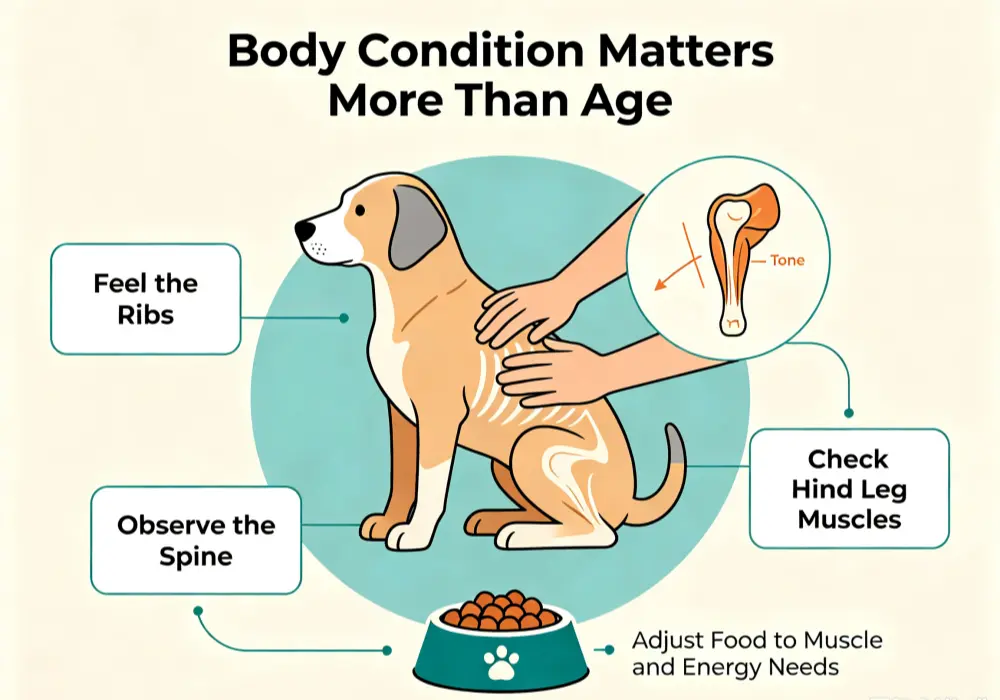
Body condition and muscle condition are different
A dog can be overweight and still lose muscle. Body Condition Score (BCS) estimates fat stores. Muscle Condition Score (MCS) evaluates muscle over areas such as the skull, shoulder blades, spine, and pelvis.
The WSAVA nutrition toolkit recommends assessing both. A thick coat or extra fat can conceal muscle loss, so the scale alone is not enough.
If the dog is losing muscle, do not simply add more meat or protein powder. First investigate pain, dental disease, inadequate calories, kidney disease, heart disease, cancer, endocrine disorders, and other possible causes.
Fat and fiber: the right balance depends on body condition
Fat provides essential fatty acids, carries fat-soluble vitamins, improves flavor, and supplies more calories per gram than protein or carbohydrate. A senior food designed for weight control may contain less fat. A food for a thin older dog may contain more.
The better choice depends on whether the dog needs fewer calories or is struggling to eat enough.
Fiber can lower calorie density, increase meal volume, and support stool quality. Insoluble fiber tends to add bulk and support intestinal movement. Fermentable fibers and prebiotics can influence the gut microbiome and production of short-chain fatty acids.
Still, the research does not show that every healthy senior dog has poor digestion. Some studies report unchanged or even improved apparent digestibility in healthy older dogs. A 2021 study of commercially relevant diets found that age did not reduce fat digestibility in healthy dogs and that some nutrient digestibility measures improved in dogs aged six to twelve when they ate a moderate-fiber diet. Read the study.
Very high fiber may be useful for an overweight dog but unhelpful for one with a small appetite. Judge the formula by stool quality, comfort, body weight, and willingness to eat.
Phosphorus, sodium, and the kidney question
Some senior foods contain less phosphorus than typical adult foods. The idea is understandable because chronic kidney disease becomes more common with age, and phosphorus restriction is an important part of many therapeutic renal diets.
But an old dog is not automatically a dog with kidney disease.
A healthy senior should not be treated as though kidney failure has already been diagnosed. The evidence supports avoiding excessive phosphorus and choosing a balanced calcium-to-phosphorus ratio, but it does not establish one strict phosphorus cap for every older dog. The report’s suggested range of approximately 0.5% to 0.7% dry matter should therefore be treated as a formulation example, not a universal target.
The same caution applies to sodium. A dog with certain heart or kidney conditions may need a specific sodium plan, while severe restriction is unnecessary for every healthy senior.
Ask your veterinarian whether baseline bloodwork and urinalysis are appropriate before a major dietary change. Testing may include kidney markers, liver enzymes, glucose, a complete blood count, urine concentration, and urine protein. The exact panel depends on the dog.
When chronic kidney disease is diagnosed, a therapeutic renal diet usually differs from ordinary senior food in several coordinated ways. It may alter phosphorus, protein quality and quantity, sodium, potassium, fatty acids, and calorie density. Picking a low number from a retail label is not equivalent to feeding a veterinary renal diet.
Omega-3s and joint support
Senior foods frequently advertise fish oil, glucosamine, chondroitin, or green-lipped mussel. Seeing one of these ingredients in the ingredient list tells you very little about the amount your dog will actually receive.
Long-chain omega-3 fatty acids, particularly EPA and DHA, have the strongest practical case among common joint-support additions. They influence inflammatory pathways and may support dogs with osteoarthritis when supplied at an appropriate amount.
Ask the manufacturer for the typical amount of EPA and DHA in the finished food, preferably per 1,000 kcal. “Contains omega-3” may include alpha-linolenic acid from plants, which is not nutritionally identical to preformed marine EPA and DHA.
Our guide to dog foods with omega-3 fatty acids explains how to compare these values.
Evidence for glucosamine and chondroitin is mixed, and the amount delivered in a normal serving may be lower than quantities used in clinical studies. A dog with arthritis still needs a broader plan that may include weight management, pain control, suitable exercise, and rehabilitation.
MCTs, antioxidants, taurine, and L-carnitine
MCTs, antioxidants, taurine, and L-carnitine appear on many senior-food labels. Their value depends on the dose, the complete recipe, and the reason you are considering them.
Medium-chain triglycerides
Some diets designed for cognitive support contain medium-chain triglycerides (MCTs). The liver can convert MCTs into ketone bodies, which provide an alternative energy source for the brain. Research on specific formulated diets suggests potential benefits for some dogs with age-related cognitive changes.
Pouring coconut oil over an ordinary meal is not an equivalent shortcut. A formulated diet controls the type and amount of fat as well as the rest of the nutrient profile. Added oil also increases calories and can cause digestive upset.
Antioxidants
Vitamin E, vitamin C, carotenoids, selenium, and other antioxidant nutrients may be included in senior formulas. Dogs still need these nutrients in appropriate, balanced amounts. More is not automatically better, and supplements can create excesses or interact with medical treatment.
Taurine and L-carnitine
Taurine and L-carnitine participate in cardiac and energy metabolism. Their inclusion on a label does not prove that every older dog needs supplementation or that a formula prevents heart disease. If a veterinarian suspects a nutritional or cardiac problem, testing and a complete diet review are more useful than adding supplements at random.
Does every older dog need senior dog food?
No. A healthy older dog may continue doing well on an appropriate adult maintenance food.
Staying with the current food can be reasonable when the dog:
- maintains an ideal body condition on a practical portion;
- retains normal muscle condition;
- has good appetite and comfortable digestion;
- can chew the food without pain;
- has no condition requiring a different nutrient profile;
- receives a complete and balanced diet from a manufacturer with sound quality control.
Consider a senior formula when the current food stops fitting the dog in front of you. Examples include gradual weight gain, reduced activity, constipation that responds to an appropriate fiber change, or a need for documented EPA/DHA. A thin dog with poor appetite may need a senior formula with higher energy density rather than the lower-calorie product most owners expect.
For a broader look at these decisions, see our guide to dog food for senior dogs.
What about “all life stages” dog food?
An all-life-stages food must meet the nutrient profile for growth and reproduction. Such foods are often more calorie-dense and may contain higher levels of some nutrients because they must support puppies and reproduction.
An all-life-stages food is not automatically unsafe for an older dog. It does mean the product may be a poor match for a sedentary senior that gains weight easily. Conversely, a highly active or underweight older dog may tolerate or benefit from greater energy density when the complete formula suits its health.
Compare the actual calories and nutrient analysis instead of rejecting the category by name. If the dog has kidney disease or another condition, let the diagnosis guide the decision.
How to compare two dog-food labels fairly

1. Read the nutritional adequacy statement
Confirm the intended life stage and whether the food is complete and balanced. Do not assume the word senior provides this information.
2. Compare calories per cup, can, or kilogram
Do not let similar-looking feeding guides hide a large difference in calorie density. Find the calorie statement and calculate the calories in the portion your dog actually receives.
3. Convert nutrients to a dry-matter basis
Wet and dry foods cannot be compared directly from the guaranteed analysis because they contain different amounts of water.
Dry-matter percentage = listed nutrient percentage ÷ (100 − moisture percentage) × 100
For example, a canned food with 8% protein and 78% moisture contains approximately 36% protein on a dry-matter basis:
8 ÷ 22 × 100 = 36.4%
Dry-matter percentages still do not show how much nutrient accompanies a given number of calories. When possible, ask for grams per 1,000 kcal.
4. Request the typical nutrient analysis
The guaranteed analysis gives minimums and maximums, not the average amount found in the food. Contact the manufacturer for typical protein, fat, fiber, phosphorus, sodium, EPA, and DHA values.
5. Ask who formulated and tested the food
The WSAVA guidance on selecting pet foods suggests asking about qualified nutrition staff, manufacturing facilities, quality control, product research, and the company’s ability to provide detailed nutritional information.
For more label-reading help, see how to understand dog-food ingredient labels.
A practical decision guide
| Your dog’s situation | Food features to discuss | Why |
| Healthy older dog at ideal weight | Current adult food or a balanced senior formula with suitable calories and adequate protein | A birthday alone does not require a change |
| Gaining weight or becoming sedentary | Lower calorie density, adequate protein, measured portions, useful fiber level | Reduces calories without shrinking the portion excessively |
| Thin, frail, or eating poorly | Higher energy density, good palatability, digestible protein, comfortable texture | Makes it easier to obtain enough calories and nutrients |
| Losing muscle while carrying extra fat | Calorie control with adequate protein; investigate underlying disease | Weight alone can hide sarcopenia |
| Osteoarthritis | Lean body condition and a documented EPA/DHA amount | Weight control and marine omega-3s may support mobility |
| Dental pain or missing teeth | Wet food, softened kibble, or another complete food the dog can eat comfortably | Texture can improve intake, but dental disease still needs treatment |
| Chronic kidney disease | Veterinarian-selected therapeutic renal diet | Ordinary senior food is not a substitute for disease-specific nutrition |
| Pancreatitis or hyperlipidemia | Veterinarian-directed fat level | Generic “low fat” marketing may not meet the required target |
| Cognitive changes | Veterinary assessment; consider a diet specifically studied for cognitive support | Disorientation and sleep changes can also have medical causes |
How to switch from adult to senior dog food
If your veterinarian does not recommend an immediate change, transition over about seven to ten days:
- Days 1–3: 75% current adult food and 25% new food.
- Days 4–6: 50% current food and 50% new food.
- Days 7–9: 25% current food and 75% new food.
- Day 10 onward: 100% new food.
Some dogs need a slower change. Hold at the current ratio for a few extra days if stool becomes mildly soft but the dog otherwise feels well. Repeated vomiting, persistent diarrhea, refusal to eat, abdominal pain, marked lethargy, or inability to keep water down calls for veterinary advice rather than a slower transition.
Keep total calories roughly consistent while mixing foods. Feeding the full old portion plus the full new portion is an easy way to cause accidental weight gain.
What to monitor after the switch
One enthusiastic meal, or one refused meal, tells you little. Watch what happens over the next few weeks. Over the following weeks, record:
- body weight;
- Body Condition Score and waistline;
- muscle over the skull, spine, shoulders, and hips;
- appetite and enthusiasm for meals;
- stool consistency and frequency;
- vomiting, gas, or abdominal discomfort;
- thirst and urination;
- mobility, energy, and recovery after exercise;
- skin and coat changes.
Recheck weight within two to four weeks. Muscle and mobility may take longer to assess. If the dog loses weight unintentionally, becomes weaker, or develops a persistent digestive change, investigate the cause instead of moving from one retail food to another.
Frequently asked questions
What is the biggest difference between adult and senior dog food?
The clearest difference is what the recipe is designed to do. Adult food supports maintenance after growth. Senior food may adjust calories, fiber, protein quality, fatty acids, minerals, texture, or functional ingredients for common age-related concerns. Because there is no separate AAFCO senior profile, the actual changes vary by product.
Is senior dog food lower in protein than adult food?
Not necessarily. Some senior foods contain more protein than standard adult formulas to help maintain lean tissue. Healthy older dogs should not receive protein restriction solely because of age. A diagnosed disease may change the recommendation.
Is senior dog food always lower in calories?
No. Many formulas are lower in calories for less active dogs, while others are more calorie-dense for thin seniors with reduced appetite. Check kcal per cup or can.
Can a senior dog keep eating adult dog food?
Yes, when the adult food remains nutritionally appropriate and the dog maintains healthy weight, muscle, appetite, digestion, and laboratory findings. Review the choice whenever the dog’s condition changes.
Can an adult dog eat senior dog food?
A healthy adult can often eat a complete and balanced senior formula, but it may not match that dog’s calorie or fiber needs. An active adult could lose weight on a low-calorie senior product. Compare the actual formula rather than relying on the age label.
Should I switch to senior food at age seven?
Seven is a common point for starting senior health discussions, not a universal switch date. Breed size and individual condition matter. Large dogs may need assessment earlier, while small dogs may remain physiologically younger for longer.
Is senior dog food better for kidney health?
Some senior foods moderate phosphorus or sodium, but they are not therapeutic renal diets. A dog with kidney disease needs a diet chosen according to disease stage, laboratory results, appetite, and other clinical factors.
How long should the transition take?
Seven to ten days works for many dogs. Dogs with sensitive digestion may need longer, while a veterinarian may direct a faster change for a medical reason.
The bottom line
The difference between adult and senior dog food comes down to the job each recipe is meant to do. The word “senior” does not promise a specific recipe. Adult maintenance foods and senior foods can overlap substantially because senior nutrition has no separate AAFCO profile.
Turn the bag around and read past the word senior. Compare calories, protein, fat, fiber, phosphorus, EPA/DHA, and feeding amount. Check both body fat and muscle. Decide whether the dog needs calorie control, greater nutrient density, a different texture, targeted joint or cognitive support, or a therapeutic diet for a diagnosed condition.
If the current adult food still fits, there may be no reason to replace it. If the dog’s weight, muscle, appetite, mobility, or health has changed, the right senior formula can be useful. Choose for the dog you have today, not for the birthday printed on a feeding chart.
This article is for general education and does not replace diagnosis or individualized nutrition advice from a veterinarian or board-certified veterinary nutritionist.
Related Articles

When to Switch Puppy to Adult Dog Food
Puppy nutrition guide When Should You Switch a Puppy to Adult Dog Food? The right time is based less on a birthday and more on your puppy's expected adult size,
Adult vs. Senior Dog Food: What’s the Difference and When Should You Switch?
The difference between adult and senior dog food is rarely obvious from one ingredient or one number on the label. Adult food covers maintenance after growth. Senior formulas often try

How to Choose Dog Food for a Senior Golden Retriever
The gray muzzle often arrives before a Golden Retriever starts acting old. That can make a food change feel premature. Yet an older Golden may already be using fewer calories,