
The simplest, most unfiltered truth about car travel with a dog is this: the absolute best way to keep dogs safe in car compartments is to never leave them in a parked car, and to never let them ride unrestrained. In a moving vehicle, a loose dog instantly turns a minor fender-bender into a preventable tragedy by becoming a heavy projectile, blocking your pedals, or pulling your eyes off the road at the wrong second.
Once you accept these two non-negotiable baselines, the rest of your travel system—harness vs. crate, gear specifications, and cargo layout—falls into place with total ease. When you actively prioritize the best way to keep dogs safe in car environments, you shift away from buying cheap pet store gimmicks and move toward crash-tested solutions backed by real physics.
Get this configuration right, and your road trips become stress-free adventures where you can focus entirely on the open road. Get it wrong, and you are constantly playing a dangerous game of luck.
Why Leaving Your Pet Parked Is Never The Best Way To Keep Dogs Safe In Car Journeys
If you are constantly searching for the best way to keep dogs safe in car trips, you must first understand the unique biology of canine thermoregulation. Dogs are not small humans; they do not sweat through their skin to cool off. They regulate their core temperature primarily through panting and very limited sweat glands in their paw pads, which is incredibly inefficient when compared to human cooling systems. A vehicle acts like a greenhouse, trapping infrared radiation and magnifying heat at an alarming speed.
Leaving the car window slightly open does not provide enough airflow to prevent this from happening. Even on what appears to be a mild day with a temperature of only 70 degrees Fahrenheit (about 21 degrees Celsius), the temperature inside the car can quickly rise to over 100 degrees Fahrenheit (about 38 degrees Celsius) before you finish your grocery shopping.
In addition to the risks posed by high temperatures, dogs moving freely inside a moving vehicle can generate catastrophic kinetic energy during emergency braking or a collision. According to automotive safety assessments, in a collision at 50 mph (about 80 km/h), a 10-pound (about 4.5 kg) dog will become a projectile, generating an impact force of approximately 500 pounds (about 227 kg). If you are driving at 30 mph (about 48 km/h) with an 80-pound (about 36 kg) retriever unrestrained in the car, the impact force can reach a staggering 2,400 pounds (about 1,090 kg). This poses a lethal threat not only to the dog but also to all passengers in the vehicle.
The Zero-Exception Parked Car Policy
Leaving your dog in a parked car “for just a second” is a dangerous gamble with their life. Parking in the shade offers no safety, as the sun moves, air conditioning systems can fail, and store lines can run longer than expected.
The absolute best way to keep dogs safe in car environments when executing standard daily errands is simple: leave them at home. If you must travel together, ensure your route is exclusively comprised of 100% pet-friendly stops where your dog never has to leave your side.
⏱️ Parked Car Temperature Escalation Matrix
| ELAPSED TIME PARKED | APPROXIMATE CABIN TEMPERATURE RISE | BIOLOGICAL IMPACT & THREAT LEVEL |
|---|---|---|
| 10 minutes | +19°F (10.55°C) | Panting mechanism begins to strain; heart rate increases slightly to dump heat. |
| 20 minutes | +29°F (16.11°C) | Risk of heat exhaustion starts rising; dog begins seeking cooler surfaces. |
| 30 to 60 minutes | +34°F to +43°F (18.89°C to 23.89°C) | Severe Danger Zone; Core body temperature rises quickly, risking fatal heatstroke in minutes. |
The Best Way To Keep Dogs Safe In Car Restraints: Crates vs. Harnesses
A leash clipped to a standard seatbelt buckle is not a vehicle safety system. A generic “pet seat belt” bought online without certified crash validation will snap, stretch, or detach under load, allowing your dog to slam into the dashboard.
When searching for the best way to keep dogs safe in car spaces, you must rely on independently certified, crash-tested hardware. The Center for Pet Safety (CPS) serves as the primary scientific benchmark, conducting rigorous sled-tests to verify harness integrity and strap elastic limits.
Option A: Anchored Crashworthy Travel Crates
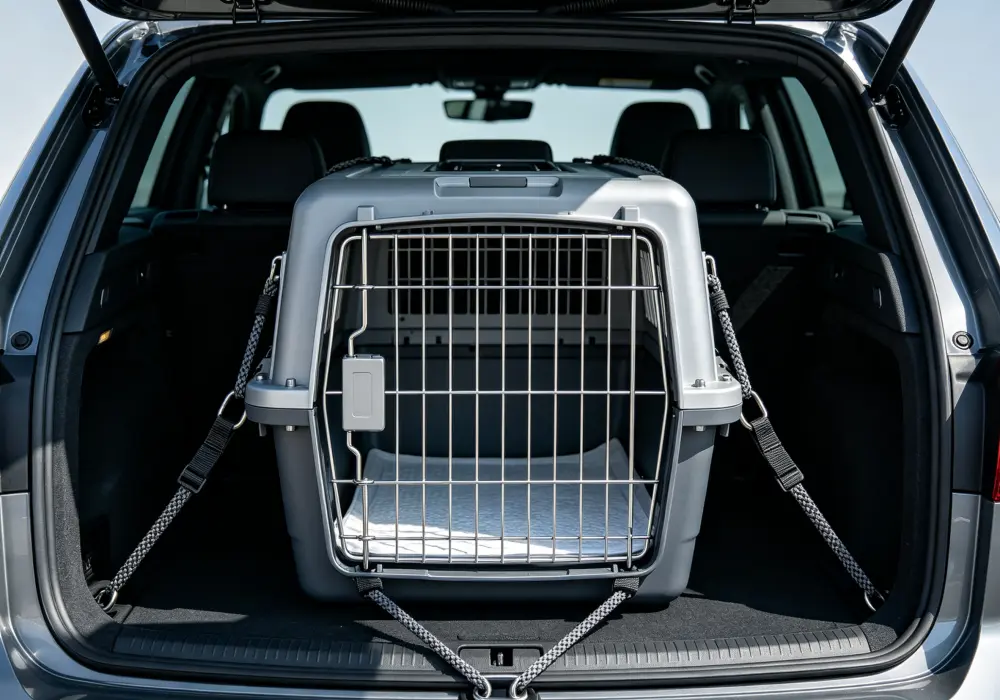
A heavy-duty, double-walled rotomolded plastic or reinforced aluminum crate acts as a protective roll-cage for your pet. In a collision, it absorbs impact forces and prevents your dog from escaping into traffic post-crash.
BEST FOR: SUVS, STATION WAGONS, DOGS THAT CHEW HARNESSES, AND MULTI-PET HOUSEHOLDS.
Option B: Crash-Tested Utility Harnesses
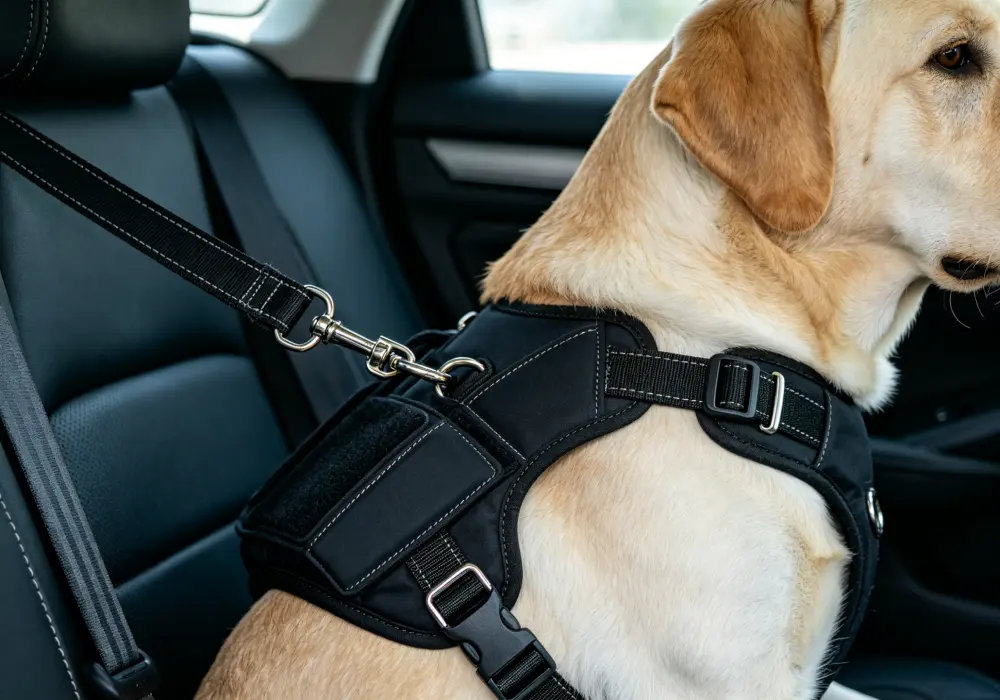
A certified harness distributes crash forces across your dog’s broad, sturdy skeletal structure—specifically the chest and rib cage—rather than pulling on the fragile neck. It securely anchors to the car’s seatbelt loop, keeping the dog centered on the seat cushion.
BEST FOR: SEDANS, CROSSOVERS, CALM MEDIUM-TO-LARGE BREEDS, AND MINIMAL CARGO SPACE.
Selecting Your Ideal Restraint Match
Determining the best way to keep dogs safe in car environments requires matching your specific dog breed, weight, and vehicle layout to the correct restraint technology:
| VEHICLE & DOG SCENARIO | RECOMMENDED RESTRAINT SYSTEM | KEY TECHNICAL JUSTIFICATION |
|---|---|---|
| SUV or Hatchback Cargo (Any size dog) | Anchored rotomolded crate / secure aluminum box | Provides a complete protective shell; keeps cargo area isolated from cabin projectile risks. |
| Standard Sedan Back Seat (Dog weight 25 to 80 lbs) | CPS‑certified crash‑tested harness | Secures the dog directly to the vehicle’s structural seatbelt pre‑tensioners. |
| Multiple Small Toy Breeds (Under 15 lbs each) | Hard‑sided travel carrier belted to the seat | Saves fragile skeletal structures from targeted harness strap pressure. |
| Short‑Snouted (Brachycephalic) Breeds | Anchored, highly ventilated travel crate | Provides maximum airflow to prevent rapid heat accumulation and respiratory stress. |
Installing Restraints: The Best Way To Keep Dogs Safe In Car Cabins
Even the most expensive, crash-tested harness or crate is useless if it is not installed correctly. If there is too much slack, your dog will swing forward like a pendulum. Follow these installation standards:
Harness Installation: The 1-Finger Tension Rule
When fitting a crash harness, you should only be able to slide one finger under the chest plate. If it sits too loose, the dog can slide out during deceleration. Keep the tether strap extremely short—the dog should be able to sit or lie down, but never stand up to “surf” on the seat. Always anchor the harness to the rear seats. Never place a dog in the front passenger seat unless you can completely disable the airbag, as a deploying airbag can easily crush a dog’s skull.
Crate Installation: The X-Pattern Anchor
Secure your travel crate to the vehicle’s metal cargo tie-down points using heavy-duty, ratcheting straps. Run the straps in an X-pattern across the top or corners of the crate to keep it from pivoting during a sudden turn or stop. Keep the interior crate bedding thin and non-slip; thick, fluffy cushions can slide and compromise your dog’s footing during deceleration.
Recognizing Stress and De-escalating Fear
Panting, whining, and pacing in the backseat are often dismissed as simple excitement, but they are common early warning signals that the motion or environment is causing your dog severe stress.
Learning to accurately read these silent cues is just as important as the physical gear you choose. If your dog struggles to settle or exhibits sudden anxiety during travel, it is highly beneficial to review our comprehensive guide to decoding dog body language.
Recognizing when your pet is in distress ensures you can stop for a walk before the stress escalates into full-blown panic. If your dog exhibits persistent, difficult-to-manage behaviors during trips, you may be dealing with a deeper behavioral trigger. Explore our strategic walkthrough on resolving chronic dog behavior problems to help rebuild confidence and trust.
Additionally, long car trips often involve frequent stops at public rest areas, exposing your pet to new environments and other animals. To protect your family during these trips, it is highly responsible to understand the diseases you can get from dogs and take simple, proactive hygiene steps to keep everyone healthy.
Travel Gear Checklist: The Best Way To Keep Dogs Safe In Car Packing Systems
An organized vehicle keeps your dog safe and comfortable. Before packing the trunk, run through this essential travel gear checklist to ensure your system is complete:
| ESSENTIAL TRAVEL GEAR | WHY IT EARNS A SPOT IN THE CAR | TECHNICAL SPECIFICATION / PRO‑TIP |
|---|---|---|
| Crash‑Tested Harness or Crate | Core life‑safety system (the foundation of vehicle safety). | Look for CPS certification or independent, high‑velocity sled‑test data. |
| Non‑Slip Seat Protector | Provides vital grip so your crate or dog’s paws don’t slide. | Choose a heavy‑duty, rubber‑backed, waterproof barrier. |
| Spill‑Proof Water Bottle | Provides clean, regular hydration without water spilling on seats. | A metal bottle is preferred over plastic in warm weather to keep water cool. |
| Cooling Mat or Damp Towel | Acts as a heat‑load buffer during hot, humid summer drives. | Use cool water, not ice water, to safely lower core body temperatures. |
| Secondary GPS Collar Tag | Prevents accidental escapes during stressful roadside breakdowns. | A physical collar tag gets your dog back faster than a microchip search. |
| Pet First‑Aid Kit | Ensures you can stabilize minor cuts or insect bites on the road. | Include cohesive wrap bandages, saline wash, tweezers, and gauze. |
For a complete assessment of your dog’s physical health and hydration status before embarking on a long road trip, cross-reference their physical state with the Signs of a Healthy Dog checklist.
🚨 Emergency Action: If You See a Dog in a Hot Car
If you spot a dog trapped in a parked car and they show signs of severe heatstroke (such as glassy eyes, heavy un-settling panting, a swollen tongue, or collapse), take immediate action:
- Gather the Facts: Note the vehicle’s make, model, color, and license plate number.
- Alert Store Management: Go inside the nearest business and request an urgent page for the driver.
- Contact Authorities: Call local non-emergency police, animal control, or 911 immediately.
- Know the Law: Many jurisdictions now carry “Good Samaritan” laws that protect you from liability if you must break a window to save an animal in imminent distress.
Securing the Journey
Ultimately, the best way to keep dogs safe in car environments is not about finding a magic accessory or relying on willpower. It comes down to implementing two strict, simple rules: never leave your dog in a parked car, and never let them ride loose in the cabin.
By choosing the right, crash-tested restraint for your vehicle and dog, installing it with the same care you would a child safety seat, and packing the essential gear to manage hydration and stress, you eliminate the risk of a travel emergency. Invest in a secure system once, enforce it consistently, and enjoy the peace of mind that comes with knowing your best friend is completely safe by your side.
Related Articles
What To Expect When Having Your Dog Put Down To Prepare Peacefully
Making the decision to say goodbye to your dog is one of the hardest things you will ever do. The phrase "put down" can feel cold and clinical, but
Training Dogs To Get Along With Each Other A Step By Step Guide
Bringing a second dog into your home doubles the potential for joy—but it can also instantly double the domestic tension if introductions go wrong. Whether you are introducing an
Best Way To Keep Dogs Safe In Car And Essential Travel Gear
The simplest, most unfiltered truth about car travel with a dog is this: the absolute best way to keep dogs safe in car compartments is to never leave them