Mental stimulation for dogs is play and problem-solving that works the brain instead of just the legs: scent games, puzzle toys, hidden treats, new tricks. A physically tired dog can still be mentally starved, and the gap usually shows up as barking or chewing. One comparison surprises most owners: 15 to 20 minutes of focused brain work burns energy comparable to a one-hour walk, because problem-solving draws heavily on glucose in the canine brain. Below you’ll find the science behind that number, seven step-by-step games that cost little or nothing, and the timing, safety, and calorie rules that make enrichment stick.
In this guide
- What is mental stimulation for dogs?
- Why dogs need mental enrichment: what the science shows
- 9 signs your dog needs more of it
- 7 brain games for dogs (step by step)
- Comparison table: which game fits your dog?
- How much mental stimulation does a dog need?
- When a puzzle backfires: the 5-step reset
- DIY enrichment safety rules
- The calorie math: enrichment without weight gain
- FAQ
What is mental stimulation for dogs?
Mental stimulation is any activity that makes your dog process information: track a scent, remember where a treat was hidden, work out how to open a lid, or learn a new word. Walks, fetch, and wrestling build muscle and stamina. They barely tax the cognitive circuits dogs evolved to use every day.
In typical homes, dogs are fed from a bowl in three seconds flat, walked on the same loop, and left alone for hours. Ethologists call this environmental under-enrichment, and it’s one of the most common root causes of behavioral complaints in companion dogs.
Canine foraging runs in two phases:
The appetitive phase
Searching, scenting, tracking, and problem-solving. This is where the brain’s dopamine-driven SEEKING system does its work, and where the joy of the hunt actually lives.
The consummatory phase
Catching, chewing, eating, then the opioid and endorphin release that calms the body down.
A standard food bowl eliminates the appetitive phase entirely. Your dog gets the calories without the hunt. Enrichment games reactivate the full sequence, and they explain a phenomenon researchers call contrafreeloading: given the choice, dogs repeatedly prefer to work for food rather than eat it free from a bowl. Your dog isn’t being difficult. Working for a living is what its brain wants.
Why dogs need mental enrichment: what the science shows
The SEEKING system: dopamine comes from the hunt, not the prize
Deep in the mammalian brain sits the SEEKING system, mesolimbic dopaminergic circuits running from the ventral tegmental area to the nucleus accumbens, amygdala, and prefrontal cortex. It generates appetitive motivation: curiosity and the urge to explore. When dogs sniff, search, and solve, the dopamine arrives during the search itself, before any reward. When the task finally succeeds, endogenous opioids and endorphins downshift the body into a state of post-enrichment calm. That combination is why a good sniffing session leaves a dog relaxed instead of wired.
The nose is a direct line to the emotional brain
Dogs have roughly 200 to 300 million olfactory receptor neurons (humans have about 6 million). Smell is also the only sense that skips the thalamus, the brain’s sensory gatekeeper, and projects straight into the limbic system, amygdala, and entorhinal cortex. That is why scent has direct access to a dog’s emotional state.
Two well-documented findings follow from this:
- In cognitive-bias experiments, dogs given regular nose work approached ambiguous situations with shorter latencies than dogs kept on rigid obedience heelwork. Researchers read this as measurable affective “optimism” (Duranton & Horowitz, 2019).
- Autonomous scent exploration also attenuates baseline cortisol and increases frustration tolerance. So when your dog spends ten minutes reading a lamppost, that counts as brain work too.
Calm, not hyped: the autonomic difference
Not all exercise is emotionally equal. Repetitive high-arousal activity, like endless ball-chucking, activates the sympathetic-adrenomedullary (SAM) axis: catecholamines and heart rate climb, and the dog stays on alert. It builds stamina while rehearsing stress. Biometric studies show the opposite profile for olfactory foraging. Pulse rate drops and heart-rate variability (HRV) rises, shifting the dog into parasympathetic (“rest and digest”) dominance. If your goal is a settled dog, scent work outperforms sprint work.
Mental work burns real energy
Sustained executive processing draws heavily on cerebral glucose. Fifteen to twenty minutes of focused problem-solving and scent discrimination expends metabolic energy comparable to about an hour of physical walking. It also produces the kind of mental fatigue that finally settles dogs who stay restless no matter how far they walk.
9 signs your dog needs more mental stimulation
Unmet cognitive needs don’t stay hidden. They surface as behavior. Watch for:
- Destructive chewing: shoes, furniture, baseboards. Oral outlets for unused problem-solving energy.
- Compulsive barking: at windows, noises, or nothing in particular.
- Attention-seeking loops: pawing, whining, nose-nudging, demand-play that escalates when ignored.
- Restlessness despite exercise: pacing and prowling even after long walks, because the body is tired but the SEEKING system is still hungry.
- Digging, scavenging, counter-surfing: self-directed foraging when no official foraging exists.
- Hyper-fixation on toys or fetch: an over-amplified appetitive drive with nowhere else to go.
- Displacement behaviors during training: out-of-context yawning, lip-licking with no food present, sudden scratching, or sniffing the ground away from the task. These signal motivational conflict, not “stubbornness.”
- Over-the-top greeting chaos: impulse-control failure at doors and arrivals.
- Apathy or shutdown: the opposite pole. A flat, disengaged dog that has simply stopped trying (learned helplessness). This one warrants a vet check too, since pain and illness can look identical.
Some of these have medical causes, so check with your vet first. In young, healthy dogs, though, this cluster usually points to one thing: a brain with no job to do.
7 brain games for dogs (step by step)
These seven games come from clinical ethology and cognitive research, and each targets a different cognitive system. All of them can be built from things already in your house. Total daily time investment: 15 to 30 minutes.
The shell game (working memory and object permanence)
The classic cup game, borrowed straight from developmental psychology. It tests Piagetian Stage 6 object permanence: your dog must understand that an object still exists when hidden, and track its invisible movement through space. It trains prefrontal executive function and inhibitory control, which is what stops impulsive pawing.
You need: 3 identical opaque cups (heavy ceramic or plastic flowerpots work; they shouldn’t tip easily) on a non-slip mat, plus smelly treats.
How to play:
- One cup: put a treat on the floor in plain view, cover it, and mark + reward the moment your dog nudges or paws the cup.
- Two cups: place a second, empty cup about 40 cm away. Bait one in full view, release with a “search” cue, and reward a correct pick. If they choose wrong, lift the cup passively to show it’s empty. No scolding. Reset.
- Three cups: slide the baited cup to a new position while your dog watches, then let them choose.
Level it up: run multiple cross-swaps; hide the swap behind an occluding screen with a 5–10 second delay to test working-memory decay; or add “scent-masked” distractor cups that smell of food but hold none, forcing fine olfactory verification.
The muffin tin matrix (mechanical problem-solving)
A multi-unit mechanical puzzle that builds spatial mapping and fine motor control. Your dog must plan: which cover, moved how, gets me food?
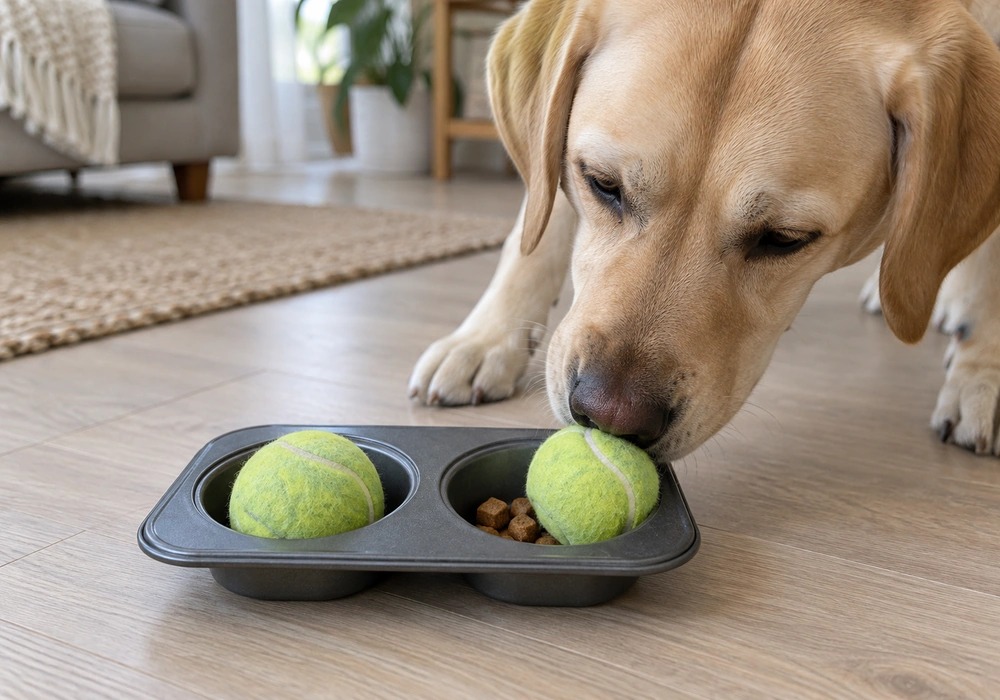
You need: a 6- or 12-cup muffin tin, plus tennis balls, solid rubber balls, or flat coasters that sit flush over the wells.
How to play:
- Familiarize: bait all wells, leave them open. Let your dog eat and build confidence.
- Loose covers: bait all wells, but rest two or three balls loosely askew so a muzzle nudge dislodges them.
- Full grid: cover every well with a ball and release your dog to lift, roll, and push.
Level it up: bait only 4–5 of the 12 covered wells so your dog must sniff and select instead of blindly clearing the array. Then swap round balls for flat wooden coasters or snug silicone lids that can’t be nose-rolled. They’ll need teeth and paws to pry.
Safety note: standard sports tennis balls carry abrasive felt that traps grit and wears down tooth enamel over time (more in the safety section). Smooth, food-grade solid rubber balls are the better long-term choice.
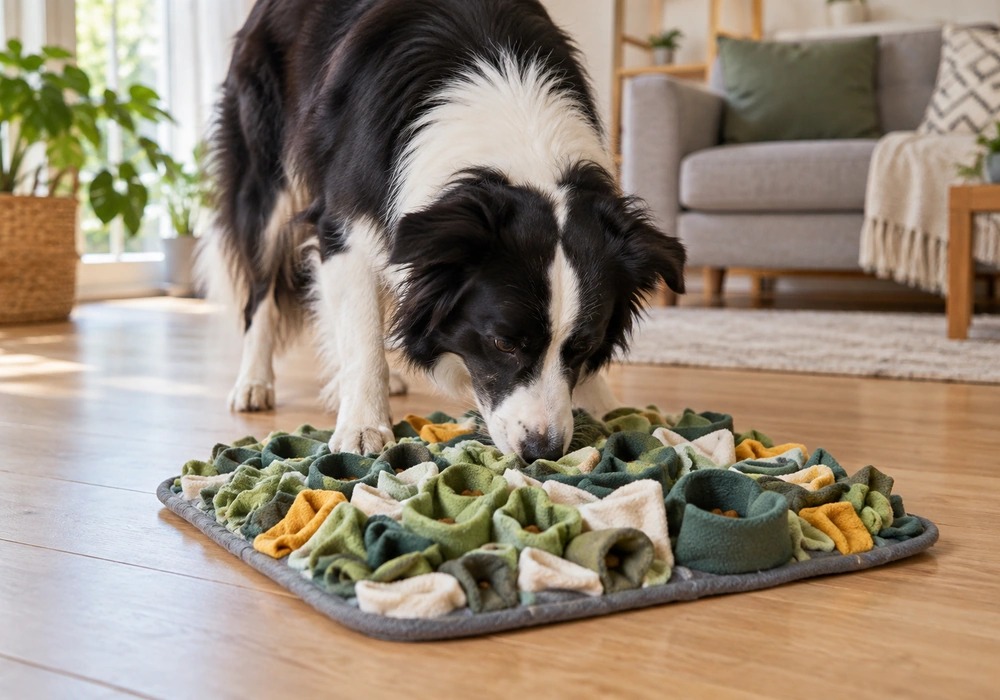
Scent trails and scatter foraging (the SEEKING system’s favorite)
The highest-value game on this list. Scatter feeding and scent tracking shift your dog from handler-focused visual orientation to autonomous olfactory search: the exact behavior their foraging sequence evolved for. Deep sniffing lowers heart rate, raises HRV, and builds the optimistic judgment bias described above.
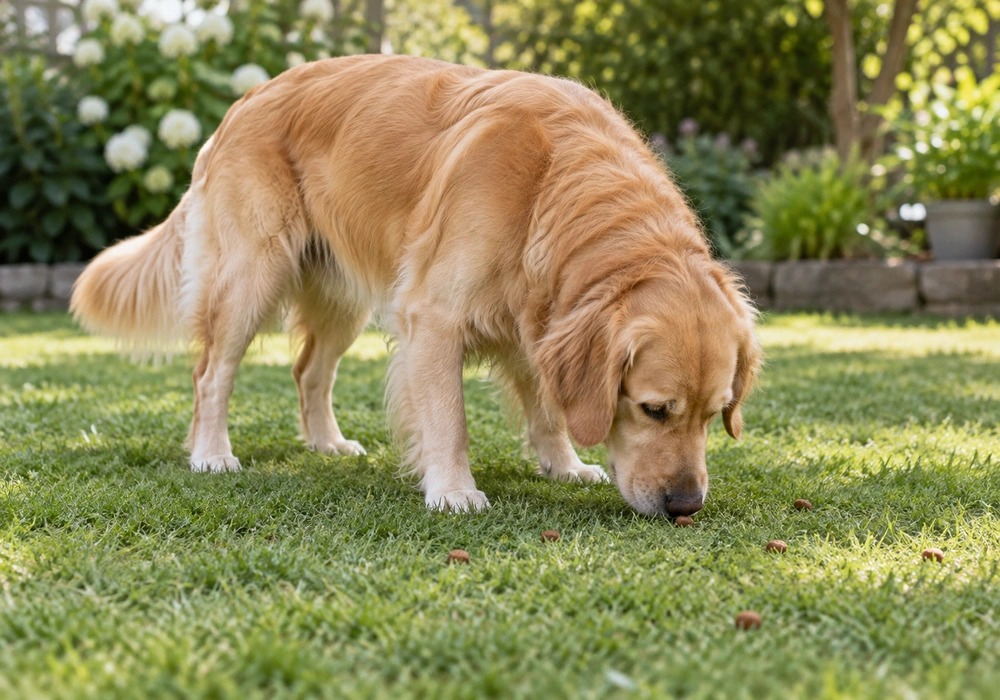
You need: part of your dog’s daily kibble ration or dehydrated single-ingredient treats, plus terrain: a lawn, leaf litter, a snuffle mat, or a rumpled fleece blanket.
How to play:
- Visual scatter: toss a handful of food across one square meter of open floor while your dog watches; release with a search cue.
- Micro-terrain concealment: press treats deep into snuffle-mat fibers or tall grass where eyes can’t help. Nose only.
- Drag trails: drag a strongly aromatic treat along a continuous zig-zag path through the room or yard, ending at a hidden jackpot.
Level it up: expand to multi-room searches with treats tucked in crevices and behind furniture legs; finally, lay non-linear blind trails aged 15–30 minutes with wind drift and decoy scents your dog must filter out.
“101 things to do with a box” (operant creativity)
Karen Pryor’s famous free-shaping game turns your dog into a creative problem-solver. There’s no lure and no cue: you reward voluntary experiments, and the dog learns to offer new ideas instead of waiting to be told what to do. It builds learning agency, persistence, and tolerance for brief frustration.
You need: a cardboard box with its edges trimmed down to about 10 cm (so it can’t shadow or trap your dog), a clicker or verbal marker, treats.
How to play:
- Place the box down. Sit nearby. Say nothing.
- Mark and reward the first voluntary interaction: an eye glance, a head turn, a step toward it, a sniff.
- Toss the treat slightly away from the box to reset your dog’s position.
- Once the behavior repeats three or four times, withhold the mark. The dog will try something new, like a paw on the edge, a push, or mouthing the rim. Mark the new thing.
Each “withhold” nudges your dog down the creativity tree toward complex chains: all four paws inside, pushing the box across the room, flipping it upside down. Advanced teams can apply the same open-ended shaping to laundry baskets, buckets, and steps.
Note: this game carries the highest frustration risk of the seven, because reinforcement is deliberately intermittent. Keep sessions short and read the reset protocol below before you start.
The rolled towel “burrito” (sequential deconstruction)
A tactile puzzle that simulates natural unbundling behavior: your dog must work through layers in sequence, planning several moves ahead. It develops bilateral paw coordination and multi-stage motor planning.
You need: a clean bath towel or fleece blanket, plus dry kibble or firm treats.
How to play:
- Accordion fold: lay the towel flat, scatter treats along its length, fold loosely in half. Treats sit at the open seams.
- Spiral roll: sprinkle treats along the towel as you roll it into a cylinder; your dog unrolls it with nose and paws.
- The knot: roll with treats inside, then tie the cylinder in a single loose overhand knot. The dog must open the knot before unrolling.
Level it up: nest the knotted roll inside a wide PVC conduit or hollow rubber toy so the fabric must be extracted before it can be unwrapped.
Toy name discrimination (vocabulary and fast-mapping)
Cognitive research with gifted word-learner dogs, the border collies Rico and Chaser, who learned over a thousand object names, shows that referential language comprehension is within canine reach. Most dogs won’t hit four figures, but three to eight names is an achievable program that trains auditory working memory and deduction.
You need: 3–8 toys that are visually and texturally distinct, each with its own name (“Ball,” “Duck,” “Rope”).
How to play:
- Condition: play exclusively with one toy while repeating its name.
- Two-object discrimination: place the named toy and one other toy two meters apart; cue the name and reward correct retrieves with play.
- Exclusion learning (fast-mapping): lay out three known toys plus one brand-new unnamed one. Ask for the new item by a brand-new word. Dogs using mutual exclusivity reasoning (the three familiar things already have names, so the new word must mean the new thing) will often fetch it on the first try.
Level it up: hide the target in an adjacent room, out of sight; then try multi-word syntax, asking your dog to distinguish “Paw Duck” (touch with paw) from “Nose Duck” (touch with nose).
“Which hand?” (impulse control in 60-second rounds)
A zero-equipment micro-game for close-range scent discrimination and self-regulation. Your dog must suppress the grab and indicate which closed fist holds the treat, using a polite nose-touch or paw-touch instead of biting and pawing at your hands.
You need: treats and your two hands.
How to play:
- Show the treat, close it in one fist, and present both closed fists 40 cm apart at muzzle height.
- Shape a clean indicator: mark and reward a gentle nose-touch to the correct hand. If they touch the empty hand, open it, show it’s empty, pause two seconds, and re-present.
- Move to scent-only: bait your hands behind your back so vision can’t help.
Level it up: rub treats across both fists so scent residue competes; cross your arms before presenting to test spatial tracking; require a sustained 3-second nose-hold on the correct hand before release.
Mental stimulation games at a glance: which fits your dog?
| Game | Primary cognitive domain | Equipment | Difficulty ceiling | Frustration risk |
| Shell Game | Working memory, object permanence | 3 opaque cups | High (multi-swaps, delays) | Moderate |
| Muffin Tin Matrix | Mechanical planning, spatial foraging | Muffin tin + balls/lids | Moderate (tight lids) | Low–moderate |
| Scent Trails & Scatter | Olfactory discrimination, sustained focus | Snuffle mat / lawn | High (blind aged trails) | Very low |
| 101 Things with a Box | Operant creativity, free-shaping | Box + clicker | Extreme (action chains) | High |
| Towel “Burrito” | Sequential motor manipulation | Bath towel | High (knotted rolls) | Moderate |
| Toy Name Discrimination | Lexical mapping, fast-mapping | 3–8 distinct toys | Extreme (exclusion, syntax) | Moderate |
| “Which Hand?” | Inhibitory control, close-range scenting | None | Moderate (crossed arms, holds) | Low |
A balanced weekly rotation covers all major systems: daily scatter feeding or a snuffle mat as the backbone, one or two “thinking” games (Shell, Muffin Tin, Towel) on alternate days, one shaping or vocabulary session for creativity, and Which-Hand rounds as a warm-up or filler.
How much mental stimulation does a dog need?
Most dogs thrive on 15–30 minutes of dedicated brain work per day, delivered as one or two short sessions of 5–15 minutes rather than one exhausting marathon.
Why so short? Focused problem-solving rapidly depletes cerebral glycogen. Beyond roughly 20 minutes, cognitive fatigue sets in: response latencies lengthen, attention wanders, and frustration risk climbs. Ending a session while motivation is still high is what builds the “enrichment is the best part of my day” association. Short daily sessions also consolidate into memory better than long weekly ones.
Adjust by life stage:
Puppies
2–5 minutes, soft criteria, heavy supervision (everything gets chewed). Scatter feeding doubles as an impulse-control teacher.
Adults
The full menu above; watch weight if the games are food-based.
Seniors
Shift toward scent-first, low-mobility games. Olfactory enrichment keeps aging brains engaged without joint strain, and short sessions suit older attention spans.
When a puzzle backfires: frustration signs and the 5-step reset
Enrichment only works while challenge and success stay balanced. When a task becomes an insurmountable barrier, eustress flips to distress: the SAM and HPA stress axes fire, dopamine transmission in the nucleus accumbens drops, prefrontal problem-solving shuts down, and your dog reverts to coping behaviors. Read the three escalation tiers:
Tier 1: displacement behaviors (early warning).
Yawning out of context, lip-licking with no food around, sudden scratching, or ground-sniffing away from the puzzle. The dog is self-soothing through motivational conflict. De-escalate now, before real frustration starts.
Tier 2: active frustration.
High-pitched barking at the toy or at you, paw-slamming, frantic biting at non-removable parts, restless pacing. Stress hormones are elevated and learning has stopped.
Tier 3: shutdown (learned helplessness).
The dog lies flat, turns away, avoids eye contact, walks off, and refuses even high-value treats. This is the state that teaches dogs trying doesn’t work. No-pain-no-gain training cultures install it accidentally.
The 5-step reset protocol:
- Calmly remove the puzzle. No scolding, no sighing, no verbal correction. Just end the failure cycle.
- Scatter a low-floor treat spread across the floor to re-engage olfaction, drop the heart rate, and restore parasympathetic tone.
- De-escalate the mechanics. Untie the knot, loosen the lids, open the compartments.
- Demonstrate. Dislodge one barrier in plain view, hand your dog the immediate win, and rebuild the solution bridge.
- Finish on success. Let your dog solve the simplified version independently, pay a jackpot, and end the session there.
The rule: always end on a success, and never train through shutdown. Dogs that end on wins get bolder. Dogs that keep failing learn to stop trying.
DIY enrichment safety rules every owner should know
DIY games are cheap and effective, but household materials bring household risks. Four rules prevent nearly every incident:
Rule 1 · Supervise every session, and police the switch. Remove the puzzle the moment the food is gone or the moment puzzle-solving turns into destructive chewing. Most DIY “danger stories” are really supervision gaps.
Rule 2 · Fabric is the serious one. Swallowed threads, fringe, or fabric strips can anchor in the stomach while peristalsis pulls the trailing end into the intestine, pleating the bowel along the taut thread. Vets call this a linear foreign body with mesenteric plication, and it can progress to bowel death, perforation, and septic peritonitis. If your dog chews towel and fleece games apart rather than unrolling them, retire those games and switch to rigid puzzles (reference).
Rule 3 · Retire abrasive tennis balls. The felt traps grit and acts like sandpaper on tooth enamel during repetitive oral manipulation, blunting teeth and exposing dentin. Use smooth solid rubber balls or wooden coasters for the muffin tin.
Rule 4 · Cardboard is food-adjacent, not food. Shaping-game boxes should be low-sided and supervise-only; dense swallowed paper wads can cause gastrointestinal obstruction.
And a baseline worth printing: no game on this list requires leaving a dog alone with it. Enrichment is interactive time. Its welfare value comes from doing it with you.
The calorie math: enrichment without weight gain
Food-based games add up fast. Veterinary nutrition standards cap supplemental treats at 10% of daily Maintenance Energy Requirement (MER):
- RER (Resting Energy Requirement) = 70 × (body weight in kg)^0.75
- MER = RER × life-stage factor (≈1.2 weight-loss, 1.4 neutered adult, 1.6 intact adult, 1.8 high-activity/working/puppy)
- Daily treat ceiling = MER × 0.10
Worked example, 10 kg neutered adult dog: RER = 70 × 10^0.75 ≈ 394 kcal/day · MER = 394 × 1.4 ≈ 552 kcal/day · Treat ceiling ≈ 55 kcal/day
What 55 kcal actually looks like (approximate portions):
| Reward | Energy density | Max daily portion |
| Standard kibble (360 kcal/100 g) | 3.6 kcal/g | ≈ 15 g |
| Boiled skinless chicken breast | ≈ 120 kcal/100 g | ≈ 46 g |
| Dehydrated beef lung | ≈ 380 kcal/100 g | ≈ 14 g |
| Steamed green beans | ≈ 35 kcal/100 g | ≈ 157 g |
Two habits make the math painless. First, use the dog’s own daily kibble ration as the primary puzzle filler, measured out of the bowl portion rather than on top of it. Second, when shaping demands high-value reinforcers, switch to low-calorie options like steamed green beans and reduce the next meal accordingly to keep daily energy neutral.
Frequently asked questions
Key sources
- Duranton, C. & Horowitz, A. — Let Me Sniff! Nosework Induces Positive Judgment Bias in Pet Dogs. Purdue Canine Welfare Program
- Object Permanence in Dogs: Invisible Displacement in a Rotation Task. PubMed 19145026
- Kaminski, J. et al. / Pilley & Reid — word learning in dogs (Rico; Chaser). Stanford Language & Cognition Lab; PMC: Vocabulary Learning in a Yorkshire Terrier
- Pryor, K. — 101 Things to Do with a Box and AKC: What Is Shaping?
- Dog and Cat Linear Foreign Body: Thread, Needle, and String Triage. NewsPet
- Guide Dogs UK — Dog Enrichment Ideas; ASPCA — Canine DIY Enrichment; PetMD — Ways to Keep Your Dog Mentally Stimulated
- The Seeking System in canine affective neuroscience. DogSmart Training & Behaviour
Technical claims in this guide are compiled from the peer-reviewed and clinical references above plus a 46-source veterinary behavioral medicine review (2026). This article is educational and does not replace individualized advice from your veterinarian or a certified behavior professional.
Related Articles
7 Fun Games for Dog Mental Stimulation
Mental stimulation for dogs is play and problem-solving that works the brain instead of just the legs: scent games, puzzle toys, hidden treats, new tricks. A physically tired dog can
Why Is My Dog’s Tongue Grey?
Canine oral health and emergency triage Why Is My Dog's Tongue Grey? A grey tongue in dogs does not always mean the same thing. Some dogs are born with dark
How to Identify Canine Hormone Imbalance Symptoms
Canine endocrine health How to Identify Canine Hormone Imbalance Symptoms Hormones influence a dog's metabolism, appetite, thirst, skin, coat, muscles, stress response, blood sugar, and reproductive cycle. Most endocrine disorders