
How Long Do Chihuahuas Live? Chihuahua Lifespan and Life Stages
A Chihuahua may share your home well into its teens, but one number cannot predict an individual dog’s future. The most useful approach is to understand the range, protect this tiny breed from preventable early hazards, and watch for the health changes that matter later in life.

The difference between an average, a median, and a breed-club estimate matters. It also explains why two trustworthy sources can give you different answers. More importantly, lifespan is only part of the story. A long life with painful teeth, excess weight, breathing difficulty, or untreated heart disease is not the same as a long healthy life.
How Long Do Chihuahuas Live in Real-World Studies?
Half of the Chihuahuas in the survival analysis lived beyond this point and half did not.
This is a practical expectation for a well-cared-for Chihuahua, not a guarantee for every dog.
Verified dogs have passed 20, but record holders should not be treated as the normal benchmark.
| Source type | Reported figure | What it tells you | Important limitation |
|---|---|---|---|
| Large UK survival analysis, 2024 | 11.8-year median | A broad population estimate that includes dogs still alive when the study ended | UK population and data sources may not represent every country or household |
| UK primary-care records, 2020 | 8.2-year median age at death | What was recorded among 102 deaths during the study period | The overall Chihuahua population was unusually young, which can pull the figure downward |
| Breed and owner guides | Often 14–16 years | A reasonable upper-middle expectation for a healthy toy breed | Usually not calculated from a representative survival dataset |
Chihuahua Life Stages: From Puppyhood to the Senior Years
Multiplying a dog’s age by seven is too crude to guide care. AAHA defines a senior dog as one entering the final 25% of its estimated lifespan, and the exact timing depends on breed, health, and the individual. For many Chihuahuas, it is sensible to begin a more deliberate senior-care conversation around 10 years of age, sometimes earlier when chronic disease is present.
Puppy: birth to about 6–9 months
Growth is fast and energy reserves are small. Very young toy puppies are vulnerable to chilling, missed meals, falls, and hypoglycemia. Safe handling and reliable feeding matter more than “anti-aging” products.
Young adult: about 9 months to 3–4 years
Build the habits that protect later health: measured meals, tooth brushing, a chest harness, calm handling, and safe interactions with larger dogs.
Mature adult: roughly 4–9 years
This is the time to look for gradual weight gain, periodontal disease, kneecap problems, coughing, or a newly detected heart murmur. Do not wait for obvious illness to establish a health baseline.
Senior: often around 10 years onward
Age is not a diagnosis. Many ten-year-old Chihuahuas remain lively, but twice-yearly examinations may reveal dental pain, muscle loss, kidney changes, arthritis, high blood pressure, or heart disease before a crisis develops.
For a practical routine covering mobility, diet, comfort, and age-related changes, see our senior Chihuahua care guide.
What Affects a Chihuahua’s Lifespan?
Preventable trauma
In the UK VetCompass study, traumatic injury accounted for 13.8% of recorded deaths with a known cause. A fall from a sofa, being dropped, a reclining chair, or a larger dog can produce injuries that would be less severe in a heavier breed.
Heart disease
Heart disease was the leading grouped cause of death in that study. Degenerative mitral valve disease becomes more relevant with age, but a murmur alone does not tell you the stage. Examination, imaging, and changes in breathing or stamina provide the clinical context.
Airway disease
Toy breeds are vulnerable to tracheal collapse. A recurrent “goose-honk” cough, cough triggered by collar pressure, noisy breathing, or poor heat tolerance deserves veterinary assessment rather than being dismissed as normal for the breed.
Dental disease
Small jaws crowd teeth. Periodontal disease was the most commonly recorded specific disorder in the VetCompass Chihuahua population. A dog may continue eating despite oral pain, so appetite alone cannot rule out dental disease.
Body condition
Small amounts of extra weight are proportionally large on a Chihuahua. Excess weight increases the workload on the airway, heart, and joints. At the other extreme, unexplained weight or muscle loss in a senior dog is also a reason to investigate.
Inherited and early-life health
Congenital heart defects, patellar luxation, eye disease, and other inherited problems can affect healthspan. “Teacup” is a marketing term, not a separate recognized Chihuahua variety, and deliberately breeding for extreme smallness may increase fragility.
How to Help Your Chihuahua Live a Longer, Healthier Life
Keep the body lean
Measure meals rather than estimating by eye, include treats in the daily total, and ask your veterinarian to record body and muscle condition. You should usually be able to feel the ribs without pressing through a thick fat layer and see a waist from above.
Brush the teeth daily
Start gradually with dog-safe toothpaste. Home brushing does not remove hardened tartar, so professional dental assessment is still important. Bad breath, bleeding gums, dropping food, or chewing on one side are not simply signs of age.
Make the home safer
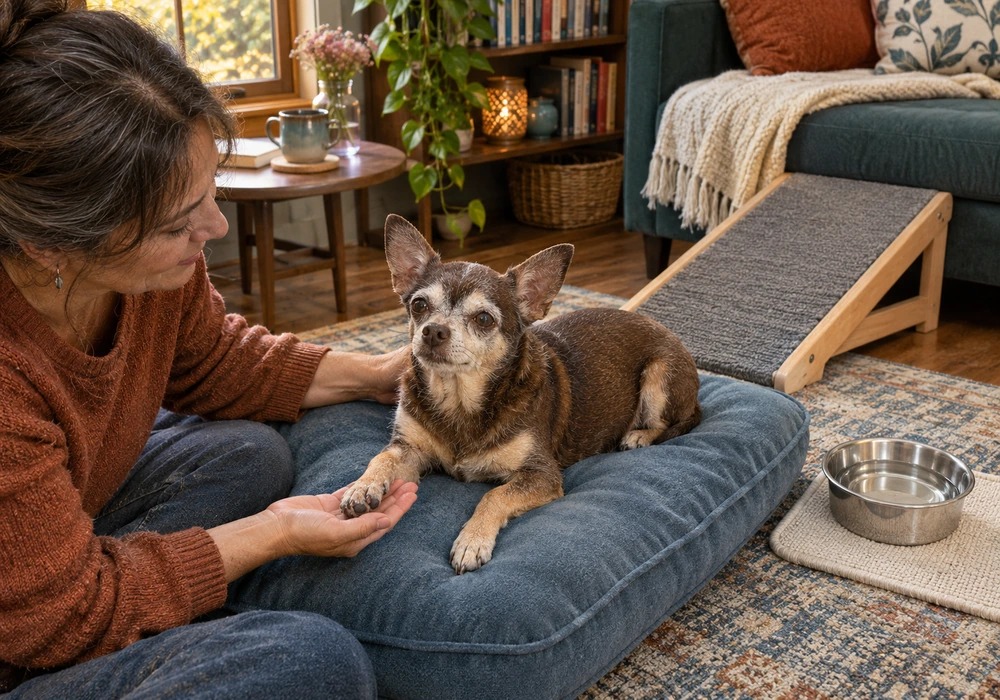
Use stable ramps or low steps, add non-slip runners, block unsafe furniture gaps, and teach children to sit on the floor while holding the dog. Check where your Chihuahua is before operating a recliner or closing a door.
Use a well-fitted harness
A chest harness avoids direct pressure on the neck. It will not prevent every airway problem, but it is a sensible everyday precaution for a dog prone to tracheal irritation or collapse.
Keep moving, but adapt
Regular walks and gentle play help preserve muscle, balance, and confidence. Shorten sessions in heat, cold, pain, or fatigue. Sudden exercise intolerance needs assessment rather than a forced fitness program.
Use preventive visits strategically
Annual examinations are a minimum for healthy adults. AAHA advises at least twice-yearly physical examinations for senior dogs, with testing tailored to the individual rather than age alone.
Build a Home Baseline Before Your Chihuahua Is Sick
A single number taken during a stressful clinic visit may not reflect what is normal at home. Record simple observations when your dog is relaxed so that a genuine change is easier to recognize.

- Weight: check monthly on the same scale when possible.
- Appetite and drinking: note a persistent increase or decrease, not just one unusual meal.
- Mobility: watch stair use, jumping, slipping, stiffness after rest, and willingness to walk.
- Sleeping breathing rate: count only when your dog is fully asleep and not dreaming or panting.
- Resting heart rate and rhythm: learn your dog’s calm baseline rather than chasing one universal target.
- Cough and stamina: note the trigger, time of day, duration, and whether recovery is slower than usual.
- Teeth and mouth: look for odor, redness, bleeding, loose teeth, facial swelling, or food avoidance.
Our Chihuahua heart rate guide explains how anxiety can temporarily increase the reading and how to check the femoral pulse at home. For comparison across breeds and sizes, use the dog heart rate chart. Breathing trends are covered separately in our resting breathing rate guide.
Warning Signs That Should Not Be Blamed on Old Age
Contact a veterinarian promptly if your Chihuahua develops a persistent new cough, reduced stamina, unexplained weight loss, dental pain, repeated limping, increased drinking or urination, confusion, or a clear change from the dog’s normal breathing or pulse.
Seek emergency care now for:
- collapse, fainting, severe weakness, or inability to stand;
- labored breathing, open-mouth breathing at rest, or obvious air hunger;
- blue, grey, white, or markedly pale gums;
- a swollen abdomen with distress or repeated unproductive retching;
- seizures, major trauma, uncontrolled bleeding, or suspected poisoning;
- trembling, profound lethargy, poor coordination, or collapse in a very young toy puppy.
Do not delay an emergency trip to repeat measurements at home. A normal-looking number cannot overrule severe symptoms.
Choosing a Chihuahua Puppy With Longevity in Mind
No breeder can guarantee a long life. Responsible breeding can, however, reduce avoidable inherited risk. Ask to see the parents’ actual health results rather than accepting “vet checked” as a substitute. The Chihuahua Club of America’s OFA/CHIC program includes breed-specific cardiac, eye, and patellar evaluations. A CHIC number means the required results were made public; it does not necessarily mean every result was normal.
- Avoid sellers who promise that an unusually tiny “teacup” puppy is healthier, rarer, or guaranteed to stay below a certain weight.
- Ask about longevity and causes of death in parents, grandparents, and earlier litters.
- Confirm that puppies are raised safely, fed appropriately, and examined for congenital problems.
- Choose stable health and temperament over extreme size, head shape, or fashionable coat color.
Frequently Asked Questions
What is the average Chihuahua lifespan?
A practical expectation is often around 14 to 16 years, but a 2024 UK population study found a median survival of 11.8 years. Different study designs produce different figures, and an individual dog may live for a shorter or longer time.
Can a Chihuahua live longer than 15 years?
Yes. Many Chihuahuas reach 15 or 16, and exceptional dogs have passed 20. Reaching an extreme age is possible but should not be treated as a promise or the definition of successful care.
At what age is a Chihuahua considered senior?
There is no universal birthday. AAHA defines the senior stage as the final 25% of expected lifespan. For many Chihuahuas, a senior-care plan becomes appropriate at about 10 years, with earlier monitoring when health problems are present.
Do long-haired Chihuahuas live longer than short-haired Chihuahuas?
There is no good evidence that coat length alone produces a meaningful lifespan difference. Health history, body condition, dental care, accident prevention, and timely treatment are more useful considerations.
Do teacup Chihuahuas have a shorter lifespan?
“Teacup” is not a recognized separate variety, and no robust lifespan study defines a precise teacup-versus-standard difference. Extremely small dogs can be more vulnerable to hypoglycemia, injury, and congenital problems, so health and responsible breeding matter more than the label.
The Bottom Line
Chihuahua lifespan is best understood as a range, not a deadline. The breed has real potential for a long life, but its tiny size creates preventable risks in youth and age-related dental, cardiac, airway, and joint concerns later on. Protect the dog in front of you: keep a lean body condition, brush the teeth, prevent falls, establish a home baseline, and investigate meaningful changes early.
Veterinary and Research References
- McMillan et al. Longevity of companion dog breeds: those at risk from early death. Scientific Reports (2024).
- O’Neill et al. Demography and commonly recorded clinical conditions of Chihuahuas under primary veterinary care in the UK in 2016.
- AAHA Canine Life Stage Definitions.
- AAHA Senior Care Guidelines: Defining the Senior Patient.
- Orthopedic Foundation for Animals: CHIC Program.
This article provides general education and cannot diagnose disease or replace care from a veterinarian who has examined your dog.
Related Articles

Puppy Won’t Settle at Night? A First-Week Bedtime Guide
Your first week together If your puppy won't settle at night, set up a safe place to sleep near you and take them for one last potty break before bed.
How Long Do Chihuahuas Live? Chihuahua Lifespan and Life Stages
Evidence-based Chihuahua longevity guide How Long Do Chihuahuas Live? Chihuahua Lifespan and Life Stages A Chihuahua may share your home well into its teens, but one number cannot predict an

What Is a Normal Chihuahua Heart Rate?
Chihuahua heart health What Is a Normal Chihuahua Heart Rate? A Chihuahua's heartbeat can feel surprisingly fast beneath your fingers. That does not automatically mean something is wrong. Age, activity,