
A practical way to feed an older Yorkie
Age changes how much food a Yorkie needs, but the date on the calendar is only part of the decision. Teeth, muscle condition, activity, appetite, and medical history matter just as much.
Quick answer: Feed a senior Yorkie a complete and balanced adult or senior diet that supplies enough digestible protein, maintains a lean body condition, and is comfortable to chew. Measure the food, divide it between two or three meals, and keep treats below 10% of daily calories. If your dog has kidney disease, pancreatitis, heart disease, serious dental problems, or an unexplained change in appetite, ask your veterinarian to tailor the diet.
A lively 8-year-old Yorkie with healthy teeth may continue to enjoy a small-breed dry food. A 13-year-old with loose teeth and early kidney disease may need a soft veterinary diet. Both are senior dogs, yet their bowls should not necessarily contain the same thing.
That is where many feeding guides go wrong. They start with a product category. It is more helpful to start with the dog standing in front of you.
When is a Yorkie considered senior?
Yorkshire Terriers often live into their teens. Many veterinary practices begin discussing senior care at about 8 years old, though there is no exact birthday when every Yorkie suddenly develops different nutritional needs.
Look at recent changes rather than age alone:
- Weight has risen or fallen
- Muscle feels thinner over the back
- Chewing appears uncomfortable
- Daily activity has declined
- Thirst or urination has increased
- Coughing has become more frequent
- Meals are sometimes left unfinished
- Blood or urine tests have changed
If none of these has changed and your dog remains lean, active, and comfortable, an immediate switch may offer little benefit. The next routine examination is a good time to review the current food and portion.
What changes as a Yorkie gets older?
Many older dogs move less and burn fewer calories. Yorkies complicate the picture because their meals are tiny. A small biscuit or spoonful of leftovers can add a surprisingly large percentage to the day’s intake.
Meanwhile, aging dogs may lose muscle. The number on the scale can stay steady while the shoulders become thinner and the waist becomes less visible. For this reason, veterinarians assess body fat and muscle separately.
Muscle
Check the temples, shoulder blades, spine, and hips. Increasing boniness in these areas may indicate muscle loss.
Teeth
Periodontal disease, loose teeth, and missing teeth can turn an ordinary bowl of kibble into a painful meal.
Body fat
Extra weight can reduce mobility and place more strain on a Yorkie that already has breathing trouble.
Digestion
Rich scraps and sudden food changes are common causes of vomiting and diarrhea, and may be especially risky after pancreatitis.
A stable weight can hide muscle loss
Run your fingers gently over your dog’s head, shoulders, spine, and hips. Then look down from above. You should be able to feel the ribs beneath a light covering of fat and see a waist behind the rib cage.

A rounder middle combined with bonier shoulders calls for a proper nutritional assessment. Simply cutting the food may reduce calories without addressing the loss of lean tissue.
Picky eating may actually be painful eating
Yorkies are prone to crowded teeth and periodontal disease. Watch what happens at the bowl. A dog with oral pain may pick up kibble and drop it, chew on one side, swallow pieces whole, or wait for softer treats.
Soft food may make dinner easier, but it cannot treat an infected or loose tooth. Bleeding gums, strong breath odor, facial swelling, or a sudden refusal to chew should lead to a dental examination.
How to choose food for a senior Yorkie
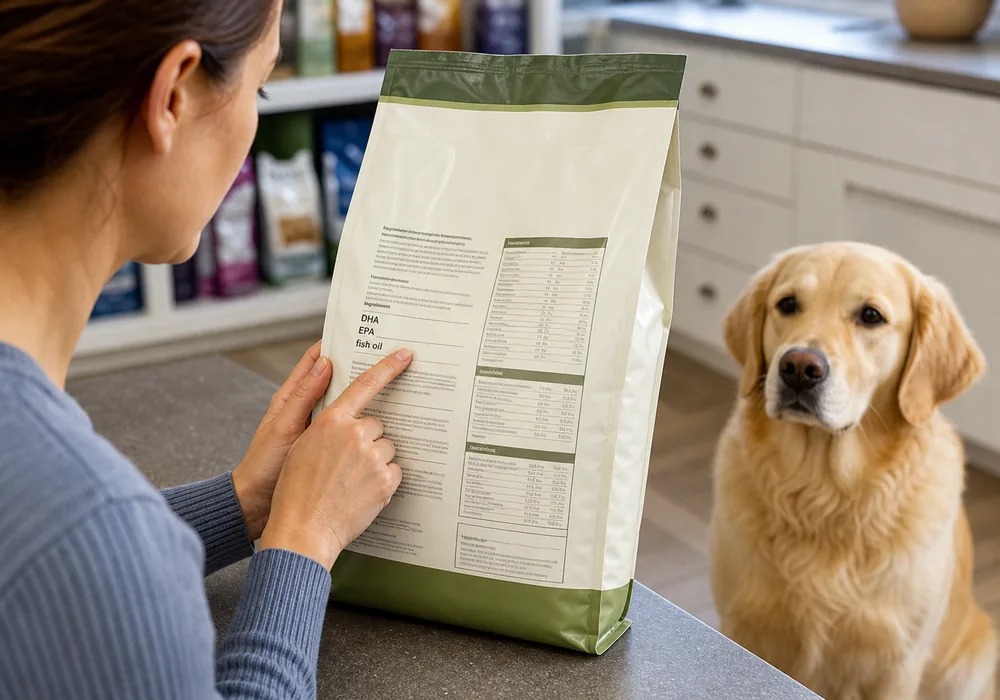
Turn the package around and find the nutritional adequacy statement. For a generally healthy senior Yorkie, the main food should normally say that it is complete and balanced for adult maintenance.
Treats, meal toppers, broths, and foods labeled for intermittent or supplemental feeding cannot be assumed to provide a complete diet.
Senior dog foods do not all follow one nutrient formula. One may be low in calories and high in fiber, while another is calorie-dense and intended for a thin dog. Read the calorie information and ask the manufacturer for a typical nutrient analysis when necessary.
It is also worth checking who formulates the food, how the company handles quality control, and whether it can answer questions about calorie and nutrient content. The ingredient list matters, but it cannot show the quality of the finished diet by itself.
Our guide to understanding dog food labels explains which parts of the package deserve the closest attention.
Protein and aging muscle
A healthy senior dog should not be placed on a low-protein diet just because of age. Older dogs still need amino acids to repair tissue and maintain muscle. The quality and digestibility of the complete diet matter alongside the percentage printed on the label.
When comparing foods, consider your dog’s muscle condition, appetite, calorie intake, digestion, and medical test results. A crude-protein number by itself cannot answer all of those questions.
Kidney disease may change the appropriate levels of phosphorus, protein, sodium, and other nutrients. These changes should be based on a diagnosis and disease stage. Restricting protein in a healthy older dog as a preventive measure may be unhelpful, particularly when muscle is already being lost.
Calories need regular adjustment
The feeding chart on a bag offers a place to begin. It cannot account for your Yorkie’s metabolism, neuter status, activity, treats, illness, or ideal weight.
Feed a measured amount for two to four weeks, then check the dog rather than trusting the chart indefinitely. A disappearing waist means the portion probably needs attention. Ongoing weight loss deserves investigation instead of automatically adding more food.
Fat needs context
Fat makes food palatable and supplies concentrated energy. That can help a thin dog with a small appetite. A dog with previous pancreatitis or abnormal blood lipids may need a carefully controlled amount instead.
Crude-fat values on wet and dry labels cannot be compared directly because the moisture content differs. Ask for values on a dry-matter or calorie basis when fat restriction is medically important.
Fiber is not one-size-fits-all
Fiber can help stool quality and may make a calorie-controlled meal more satisfying. Too much may leave a thin Yorkie unable to eat enough calories.
Persistent constipation or loose stool should not be managed by repeatedly adding pumpkin without knowing the cause. Different fibers work differently, and bowel changes may come from disease, medication, parasites, or food intolerance.
Water in the diet
Canned food usually contains much more water than kibble. Some older dogs enjoy the softer texture and stronger smell. Dry food can also be moistened immediately before serving.
Water content is only one feature of the food. A moist product still needs to match the dog’s calorie and nutrient requirements.
EPA and DHA
Marine omega-3 fatty acids may be included in foods intended to support joints, skin, kidneys, or cognitive health. More is not automatically better. Fish-oil products vary widely in their EPA and DHA content, and the oil adds calories.
Ask your veterinarian before adding a concentrated supplement, particularly if your dog has a medical condition or takes medication. You can also read our guide to DHA in dog food.
Dry food, wet food, or softened kibble?
Choose a format your Yorkie can pick up and swallow without hesitation or pain. Texture preference alone does not tell you whether a food is nutritionally suitable, so check both comfort and adequacy.

| Food format | When it may work | What to check |
|---|---|---|
| Small-breed dry food | The mouth is healthy and chewing is comfortable | Calorie density, piece size, and accurate portion weight |
| Wet pâté or loaf | Teeth are missing or chewing is uncomfortable | Calories per can or gram and the adequacy statement |
| Softened kibble | The current food is tolerated but needs a softer texture | Soften the center fully and discard uneaten food promptly |
| Complete fresh food | The dog prefers a moist, aromatic meal | Professional formulation, nutritional adequacy, and safe handling |
| Veterinary diet | A diagnosed disease needs nutritional treatment | Follow the prescribed amount and avoid unapproved extras |
How to soften kibble
Measure the dry portion first. Add warm water, stir, and wait until the pieces are soft all the way through. Check the temperature before serving. Refrigerate or discard leftovers promptly because moistened food should not sit out for hours.
Use plain water unless your veterinarian approves another liquid. Many packaged broths contain onion, garlic, or too much sodium.
For more help with texture and appetite, see what to feed senior dogs with missing teeth or low appetite.
Be careful with homemade diets
Chicken, rice, and vegetables do not form a balanced long-term diet by themselves. The mixture may be short of calcium, trace minerals, vitamins, and essential fatty acids even when the ingredients look wholesome.
Owners who want to cook every meal should use a recipe formulated for their dog by a board-certified veterinary nutritionist and follow it without casual substitutions.
How much should a senior Yorkie eat?
Cup measurements are especially awkward for Yorkies. Food products differ in calorie density, and the amount inside a loosely filled scoop may not match a packed one.
Veterinary teams sometimes begin with the Resting Energy Requirement formula:
RER estimates resting energy use. It is not an automatic daily ration. Activity, ideal weight, neuter status, health, and recent weight changes still need to be considered.
| Yorkie’s weight | Approximate RER | Meaning |
|---|---|---|
| 3 lb (1.36 kg) | 88 kcal/day | Calculation starting point |
| 4 lb (1.81 kg) | 109 kcal/day | Calculation starting point |
| 5 lb (2.27 kg) | 129 kcal/day | Calculation starting point |
| 6 lb (2.72 kg) | 148 kcal/day | Calculation starting point |
| 7 lb (3.18 kg) | 166 kcal/day | Calculation starting point |
| 8 lb (3.63 kg) | 184 kcal/day | Calculation starting point |
These numbers are not fixed feeding amounts. Some Yorkies need more, while others need less. A weight-loss calculation may also use the dog’s ideal weight rather than the current weight.
Convert calories to grams
Find the food’s calories per gram on the label or ask the manufacturer. Once you have a sensible daily calorie target, use this calculation:
Suppose the food contains 3.6 calories per gram and the recommended daily target is 150 calories:
Three meals would contain about 14 grams each. The example shows how the arithmetic works. It does not prescribe 150 calories for every Yorkie of a certain weight.
Weigh small portions
A digital kitchen scale is more consistent than a measuring cup. Put the empty bowl on the scale, press tare, and add food until the intended gram amount appears.

Measure treats too, or reserve part of the normal meal for rewards. With such a small dog, unnoticed extras add up quickly.
Meals and treats
Most senior Yorkies manage well on two or three measured meals a day. A third small meal may suit a dog that struggles to finish a large serving, needs medication with food, or becomes nauseated after a long period with an empty stomach.
A regular schedule also makes appetite easier to judge. Free-feeding can hide a gradual decline, especially when another pet has access to the bowl.
Weakness, trembling, poor coordination, collapse, or seizures require prompt veterinary care. These signs should not be treated at home as ordinary hunger without finding the cause.
How many treats can a Yorkie have?
Keep treats and other incomplete extras below 10% of total daily calories. This includes dental chews, supplements, toppers, table food, and anything used to hide medication.
If a Yorkie eats 160 calories a day, the treat allowance is about 16 calories. One rich chew may use most of it.
- Set aside some of the daily kibble for rewards.
- Break soft treats into very small pieces.
- Count the calories in chews and supplements.
- Keep one treat container for the whole household.
- Use attention, play, or praise when food is unnecessary.
How to change foods without upsetting the stomach
Many dogs tolerate a seven-day transition. A Yorkie with a sensitive stomach may need ten days or longer.
| Period | Current food | New food | What to watch |
|---|---|---|---|
| Days 1–2 | 75% | 25% | Appetite, vomiting, and stool consistency |
| Days 3–4 | 50% | 50% | Nausea, gas, discomfort, or soft stool |
| Days 5–6 | 25% | 75% | Comfortable chewing and normal meal completion |
| Day 7 onward | 0% | 100% | Weight, stool, appetite, and energy |
If the stool becomes slightly soft, remain at the current ratio for another day or two. Repeated vomiting, bloody stool, marked lethargy, abdominal pain, food refusal, or an inability to keep water down calls for veterinary advice.
When a medical condition changes the menu
A general senior food is made for a generally healthy dog. Once a medical condition has been diagnosed, a veterinary therapeutic diet may be more appropriate.
Dental disease
Switching to a softer texture can make eating more comfortable. It should happen alongside dental care rather than in place of it. Loose teeth, bleeding gums, swelling, or pain need treatment.
Pancreatitis or high blood lipids
A dog with previous pancreatitis may need a consistent, veterinarian-selected fat level. Bacon, sausage, cheese, gravy, butter, poultry skin, and oily leftovers are poor appetite enhancers for these dogs.
Do not choose a medically low-fat diet from the front of the package. The relevant value may need to be compared on a dry-matter or calorie basis.
Kidney disease
Kidney diets are built around several nutritional changes, often including phosphorus and adjustments to other nutrients. The right plan depends on disease stage, blood and urine results, blood pressure, appetite, weight, and muscle condition.
Do not reduce protein in a healthy senior Yorkie simply as a precaution. If kidney disease has been diagnosed, discuss the appropriate therapeutic diet with the veterinarian treating your dog.
Heart disease
Yorkies can develop degenerative mitral valve disease. A murmur does not always require aggressive sodium restriction, though salty processed foods remain a poor routine choice.
Report persistent coughing, faster breathing during sleep, reduced exercise tolerance, fainting, or abdominal swelling. Diet cannot determine the cause of these signs.
Tracheal collapse and excess weight
A leaner body may ease some of the physical burden on a compromised airway. Weight loss should be gradual, with enough protein and essential nutrients to protect muscle.
Feeding much less of an ordinary maintenance food may also reduce vitamin and mineral intake. A complete calorie-controlled diet is often a better approach.
Loss of appetite
Warming wet food slightly can release more aroma. A soft texture, smaller fresh meals, and a quiet eating space may also help.
Do not cover up ongoing appetite loss with increasingly rich toppers. Dental pain, nausea, kidney disease, medication effects, infection, and pancreatitis are among the possible causes.
Foods to keep away from a senior Yorkie
| Food or item | Why it is a problem |
|---|---|
| Fatty meat, bacon, sausage, poultry skin, butter, and gravy | Digestive upset and pancreatitis risk |
| Onions, garlic, leeks, shallots, and chives | Damage to red blood cells |
| Grapes, raisins, currants, and sultanas | Potential acute kidney injury |
| Xylitol-containing products | Rapid hypoglycemia and possible liver injury |
| Chocolate, caffeine, and alcohol | Potentially serious poisoning |
| Raw yeast dough | Expansion and alcohol production in the digestive tract |
| Cooked bones, antlers, hooves, and very hard chews | Broken teeth, choking, or digestive obstruction |
| Heavily salted processed food | Unnecessary sodium load |
Xylitol may appear on labels as birch sugar, wood sugar, or birch bark extract. If your dog may have swallowed it, contact a veterinarian, emergency clinic, or animal poison service immediately. Do not wait for symptoms.
Let your Yorkie tell you whether the diet is working
Check the result of the feeding plan every few weeks. Keep a simple note of body weight, appetite, stool, vomiting, thirst, urination, coughing, breathing, energy, and chewing comfort.
Feel the ribs and look for a waist. Then check muscle over the temples, shoulders, spine, and hips. An overweight dog can still be losing muscle underneath the fat.
Arrange a veterinary examination for:
- Unexplained weight loss or gain
- Reduced appetite lasting more than a day
- Dropped food, bleeding gums, or trouble chewing
- Repeated vomiting or diarrhea
- Black, tarry, or visibly bloody stool
- Markedly increased thirst or urination
- Weakness, trembling, collapse, or seizures
- A painful or swollen abdomen
- Persistent coughing or abnormal breathing
- Noticeable loss of muscle
- Confusion or major changes in sleep and behavior
Older Yorkies may have several health problems at the same time. Food that suits one condition may be unsuitable for another. Regular examinations and appropriate laboratory tests allow the feeding plan to change with the dog.
Frequently asked questions
What is the best food for a senior Yorkie?
Choose a complete and balanced food that keeps the dog lean, supports muscle, and is comfortable to eat. Calorie density, quality control, medical suitability, and your dog’s response are more useful than words such as premium or natural.
Should a senior Yorkie eat wet or dry food?
Both can work. Dry food may suit a dog with a healthy mouth. Wet or softened food is often easier for a dog with missing or painful teeth. Check that the main food is complete and balanced.
Does a senior Yorkie need grain-free food?
Age and breed alone are not reasons to avoid grain. Choose food according to nutritional adequacy, calorie content, manufacturer expertise, tolerance, and medical needs.
Can a senior Yorkie live on chicken and rice?
No. Chicken and rice do not provide complete long-term nutrition. They may occasionally be used for a short period under veterinary guidance, but a permanent homemade diet needs professional formulation and supplementation.
How many meals should a senior Yorkie eat?
Two or three measured meals suit most senior Yorkies. Smaller, more frequent meals may help a dog that struggles with larger portions or needs closer appetite monitoring.
How can I tell whether I am feeding too much?
Weight gain, loss of a visible waist, and ribs that become harder to feel suggest excess calorie intake. Weigh the main food in grams and count treats, chews, toppers, and medication foods.
Does every older Yorkie need senior dog food?
No. A healthy older dog may continue to do well on an appropriate adult-maintenance food. Review the diet when weight, muscle, appetite, activity, dental comfort, or medical results change.
What can I add if my Yorkie will not eat?
Try warming an appropriate wet food or softening the usual diet with warm water. Avoid fatty or salty toppers. If poor appetite continues, arrange an examination instead of repeatedly changing the meal.
The bottom line
What to feed a senior Yorkie depends on the dogcial in front of you. Begin with a complete and balanced food, supply enough digestible protein, keep portions accurate, and choose a texture your dog can eat comfortably.
Weigh the food in grams, divide the daily ration between two or three meals, and keep treats below 10% of total calories. Watch your Yorkie’s weight, muscle, appetite, digestion, dental comfort, and breathing.
A healthy senior Yorkie does not need arbitrary nutrient restrictions. A dog with kidney disease, pancreatitis, heart disease, obesity, or serious dental problems may need a therapeutic diet selected with veterinary guidance.
References and further reading
Related Articles

when to switch puppy to adult dog food
Puppy nutrition guide When Should You Switch a Puppy to Adult Dog Food? The right time is based less on a birthday and more on your puppy's expected adult size,
What Is DHA and Why Is It Important in Dog Food?
Canine nutrition guide DHA in dog food helps build and maintain the brain, eyes, and nervous system. Puppies have the greatest nutritional demand because their brains and vision are developing

Dog Breathing Fast While Sleeping: When to Worry
Seeing your dog breathing fast while sleeping can be unsettling, especially when the room is cool and your dog has not been exercising. Sometimes the explanation is simple: your dog