
Put a hand on a small dog’s chest and the heartbeat can feel alarmingly quick. Try the same thing with a sleeping Great Dane and the pulse may seem slow. Both readings can be normal. Heart rate changes with age, body size, activity, stress, pain, temperature and fitness.
For most adult dogs, commonly used veterinary references place the resting heart rate at roughly 60 to 140 beats per minute (bpm). Small dogs and puppies usually run faster. Large, relaxed or athletic dogs may run slower. Before worrying about a number, check whether your dog is truly resting and whether anything else looks wrong.
Use the chart as a reference, then compare it with your dog’s usual resting rate. Below it, you will find two ways to count a pulse and a clear list of signs that should not wait.
Quick answer: Count when your dog is calm and resting. A regular pulse close to their usual rate is more reassuring than one odd reading. Get urgent veterinary help if the heartbeat is unusually fast, slow or irregular and your dog collapses, struggles to breathe, becomes weak, or has pale or blue-gray gums.
Dog Heart Rate Chart by Age and Size
These are broad reference ranges, not diagnostic cutoffs. Veterinary sources group dogs by size in different ways, and a nervous dog may read much higher in a clinic than at home.
| Dog’s age or size | Approximate resting heart rate | Useful context |
|---|---|---|
| Newborn puppy, 0-2 weeks | 160-220 bpm | Very young puppies depend heavily on heart rate to maintain circulation. A weak, cold or unresponsive newborn needs prompt veterinary help regardless of the number. |
| Young puppy, 2-8 weeks | 140-200 bpm | Rates are normally faster than in adult dogs and may rise further with handling or crying. |
| Older puppy or adolescent | 100-160 bpm | The rate gradually slows as the puppy matures; breed size begins to matter more. |
| Toy and small adult dog | About 90-140 bpm | Small dogs often have faster clinic readings, particularly when nervous. |
| Medium adult dog | About 70-120 bpm | Calm home readings may sit toward the lower part of the range. |
| Large or giant adult dog | About 60-100 bpm | Fit, relaxed large dogs can have slower pulses than small dogs. |
| Conditioned athletic dog | Sometimes 40-60 bpm at deep rest | A low rate can be normal when the dog is bright, comfortable and has strong pulses, but new weakness or fainting is not normal. |
The Merck Veterinary Manual lists 70-120 bpm as a general resting reference and notes that small dogs tend to run faster than large dogs. Other veterinary first-aid sources use wider ranges. There is no contradiction here: the setting and the individual dog change what a reasonable reading looks like.
Why Small Dogs Usually Have Faster Heart Rates
A Chihuahua and a Great Dane do not move the same amount of blood with each heartbeat. Larger dogs have larger heart chambers and can pump more blood per beat. Small dogs have smaller stroke volumes, so their hearts generally beat faster to support circulation and metabolism.
Puppies are different again. Their cardiovascular and autonomic nervous systems are still maturing, so they depend more heavily on heart rate to maintain blood flow. A rate that would be unusual in a calm adult can therefore be expected in a newborn.
Then there is temperament. A nervous toy dog on an examination table may have a much faster pulse than the same dog asleep on the sofa.
Resting Heart Rate, Sleeping Heart Rate and Clinic Heart Rate
First, note where and when you took the reading.
Resting heart rate
Take a resting measurement after several quiet minutes. A dog that has just exercised, barked at a visitor, ridden in the car or resisted handling is not yet at rest. Wait until the excitement has passed.
Sleeping heart rate
Heart rate often drops during deep sleep as “rest-and-digest” activity takes over. Dreaming and twitching can briefly speed it up. Wait for a quiet stretch of sleep instead of counting during an active dream.
Veterinary-clinic heart rate
A clinic reading may be higher simply because the dog is frightened or excited. This is common in anxious small dogs. Your veterinarian will look at the whole examination and may repeat the count after your dog settles.
How to Check Your Dog’s Heart Rate at Home
You can get a useful reading with your fingertips and a phone timer. Choose a calm moment and do not rush the count.
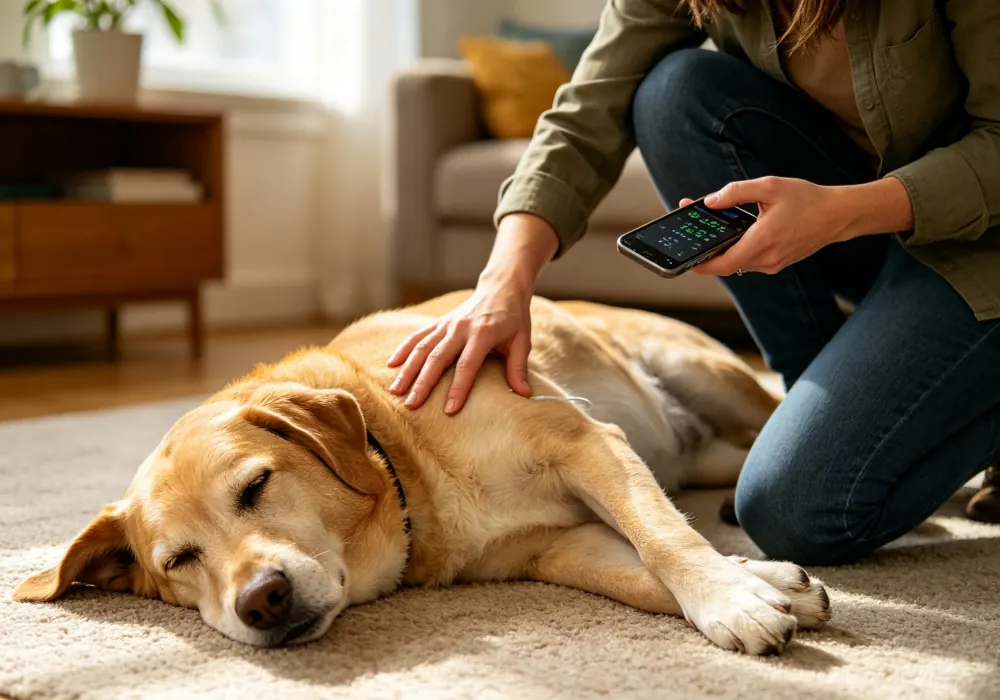
Method 1: Feel the heartbeat through the chest
- Let your dog lie on their right side or stand comfortably.
- Place your hand on the left side of the chest, just behind the front elbow.
- Move your fingertips slightly until you feel the strongest beat.
- Count each beat for 30 seconds and multiply by two.
- If the rhythm feels uneven, count for a full 60 seconds instead.
Method 2: Feel the femoral pulse
- Ask your dog to stand or lie comfortably.
- Place two fingertips high on the inside of a back leg, where the leg meets the body.
- Press lightly until you feel the femoral artery pulsing.
- Count for 30 seconds and multiply by two.
- Repeat the measurement after a minute if the result surprises you.
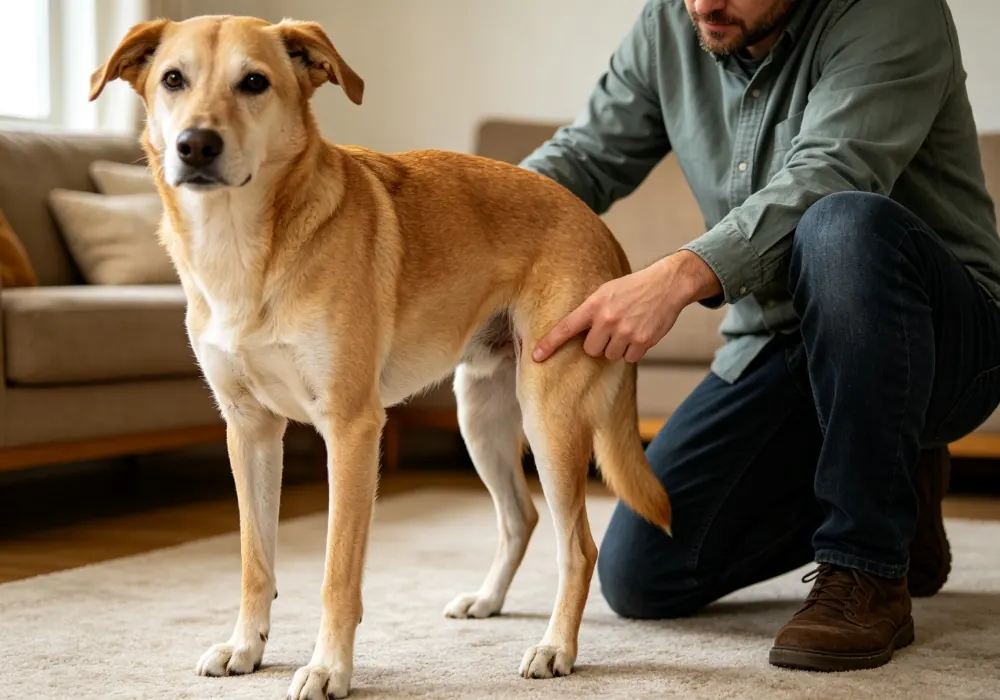
Use your index and middle fingers rather than your thumb. Your thumb has a noticeable pulse of its own and can confuse the count.
When a 15-second count is not enough
Counting for 15 seconds and multiplying by four is convenient when the rhythm is steady. It is less reliable when the heartbeat speeds up and slows down, when the rate is unusually low or when beats appear to be skipped. In those situations, count for the full minute and contact a veterinarian if the irregularity persists.
A Simple Heart Rate Calculation
Use this formula:
Heart rate in bpm = beats counted / seconds counted x 60
Examples:
- 28 beats in 15 seconds = 112 bpm
- 48 beats in 30 seconds = 96 bpm
- 72 beats in 60 seconds = 72 bpm
Write down whether your dog was awake, asleep, panting, nervous or recently active. A bare number is easy to misread later.
Is an Irregular Heartbeat Always Abnormal?
No. Many healthy, relaxed dogs have respiratory sinus arrhythmia: the heart speeds up slightly during inhalation and slows during exhalation. To an untrained hand, that normal pattern can feel uneven.
The pattern often fades during exercise, pain or stress. Still, an uneven pulse at home cannot be assumed to be harmless. Abnormal rhythms can also cause pauses, sudden rapid runs or skipped pulses.
Arrange veterinary assessment when an irregular rhythm is new, persistent or accompanied by weakness, fainting, exercise intolerance or breathing changes. An electrocardiogram, and sometimes a wearable Holter monitor, may be needed to identify the rhythm.
What Is a Pulse Deficit?
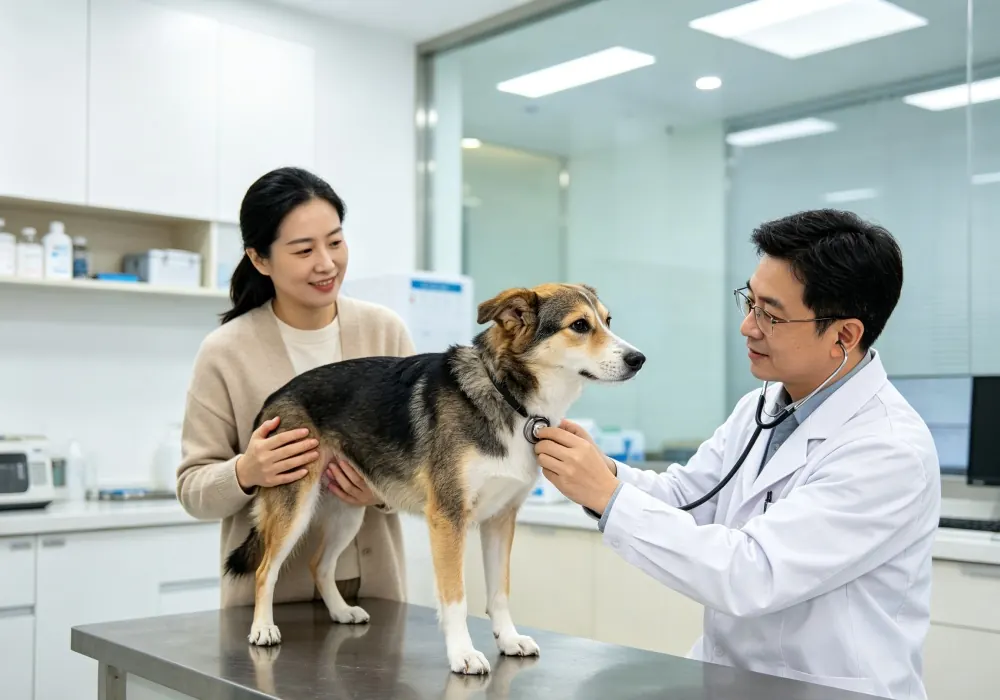
If you can hear or feel the heartbeat through the chest while also feeling the femoral pulse, each heartbeat should normally create a corresponding pulse wave. Sometimes the heart contracts too early or too weakly to push a noticeable wave to the leg. The result is an audible heartbeat without a matching peripheral pulse, called a pulse deficit.
Do not try to name the rhythm yourself. If chest beats and femoral pulses repeatedly fail to match, particularly in a weak or unwell dog, call a veterinarian promptly. An ECG can show what is actually happening.
What Can Temporarily Increase a Dog’s Heart Rate?
A fast reading does not automatically mean heart disease. Short-term causes include:
- Exercise or play
- Excitement, fear or restraint
- Panting in hot weather
- Pain
- Fever
- Dehydration
- A recent car ride or veterinary visit
- Certain medications
If your dog otherwise looks well, move to a quiet, comfortable place and allow time to settle. Do not keep retesting a dog that is struggling to breathe, collapsing, bleeding, overheating or showing abnormal gum color. That dog needs help.
A persistently fast resting pulse has a different meaning. Anemia, blood loss, shock, infection, heart failure and abnormal electrical rhythms are among the possibilities, and a chart cannot tell them apart.
What Can Make a Dog’s Heart Rate Slow?
A low resting heart rate may be normal in a sleeping, large or well-conditioned dog. It can also occur with hypothermia, certain medications, electrolyte abnormalities, endocrine illness or a disturbance in the heart’s electrical conduction system.
The dog’s condition breaks the tie. A relaxed athlete with a slow, strong, regular pulse may be fine. Pair that same number with weakness, confusion, pale gums, collapse or poor exercise tolerance, and it needs veterinary attention.
Senior dogs deserve particular attention when a slow or irregular rhythm is new. Aging can affect the sinus node and electrical conduction pathways, while degenerative valve disease and other heart problems become more common.
When Is a Fast Heart Rate an Emergency?
No single at-home cutoff works for every dog. A frightened puppy and a sleeping Great Dane should not be judged by the same number.
Seek emergency veterinary care when an abnormal heart rate occurs with any of the following:
- Collapse, fainting or inability to stand
- Labored, noisy or open-mouth breathing at rest
- Blue, gray, very pale or muddy-colored gums
- A weak or barely detectable pulse
- Sudden extreme lethargy or confusion
- A swollen or painful abdomen
- Significant bleeding or suspected internal bleeding
- Heatstroke signs
- Suspected toxin or medication exposure
- Sustained racing heartbeat while the dog is genuinely calm
If your dog is unconscious and not breathing normally, contact an emergency veterinary service immediately and follow professional pet-CPR instructions. Do not give human heart medication or attempt physical “vagal maneuvers” at home.
Build a Personal Resting Heart Rate Baseline
One reading is a snapshot. For a healthy dog, take two or three calm resting measurements over a week, using the same position and method each time. That gives you a baseline worth comparing against.
Your log might include:
| Date and time | Heart rate | Dog’s state | Rhythm felt steady? | Other observations |
|---|---|---|---|---|
| Monday, 9 p.m. | 76 bpm | Awake and relaxed | Yes | Pink gums, breathing quietly |
| Wednesday, 10 p.m. | 68 bpm | Sleeping | Slight variation with breathing | Comfortable |
| Saturday, 3 p.m. | 104 bpm | Recently greeted visitor | Yes | Excited but settled quickly |
There is no need to check all day. Call your veterinarian if the resting rate shifts noticeably from the usual pattern, stays outside the range set for your dog or changes along with new symptoms.
Dogs already diagnosed with heart disease may have an individualized monitoring plan. Follow that plan rather than a general internet chart. In many dogs with congestive heart failure risk, veterinarians also ask owners to track sleeping respiratory rate because a rising respiratory trend can help identify fluid accumulation.
Heart Rate Should Be Checked With Other Vital Signs
A pulse makes more sense beside the other vital signs. Check:
- Breathing: Is it quiet and effortless, or is the abdomen working hard?
- Gum color: Are normally unpigmented areas pink, or are they pale, blue-gray, brick red or muddy?
- Capillary refill: After gently pressing an unpigmented gum until it lightens, color commonly returns in about one to two seconds. Do not rely on this test alone.
- Pulse quality: Does the pulse feel strong and consistent or weak and thready?
- Mental state: Is your dog alert and responsive?
- Temperature and environment: Has the dog been exercising or exposed to heat?
You can compare these observations with our guides to the normal breathing rate for dogs at rest and the dog gum color chart. If several vital signs are abnormal at once, the situation is more concerning.
Common Heart Rate Measurement Mistakes
The easiest mistake is counting too soon after play, a car ride or a burst of barking. Wait until the dog has fully settled unless illness is the reason you are checking. A post-play pulse is not a resting heart rate.
Make sure you are counting heartbeats rather than panting movements. Feel the chest or femoral artery directly, using your index and middle fingers. Avoid your thumb because its own pulse can interfere with the count.
Repeated handling can make an anxious dog more worked up and push the number higher. Stop, give the dog space and try later if there are no warning signs.
Wearable collars have their own problem: movement, fur and poor skin contact can produce strange readings. Confirm an unexpected alert manually and look at the dog. When a rhythm problem is suspected, an ECG or veterinary Holter monitor is far more useful than a consumer device.
Most importantly, do not use the chart as a diagnosis. A normal-looking number cannot rule out heart disease, and an abnormal number does not tell you the cause.
Frequently Asked Questions
What is a normal resting heart rate for a dog?
A commonly cited general range is around 60-140 bpm, although some veterinary references use 70-120 bpm. Puppies and small dogs tend to be faster; large, sleeping or athletic dogs may be slower. Measure when the dog is calm and interpret the result with symptoms and the dog’s usual baseline.
What is a normal heart rate for a small dog?
Approximately 90-140 bpm is a practical adult screening range. A nervous clinic reading may be higher than a relaxed home reading. Ask your veterinarian what range is appropriate for your individual dog.
What is a normal puppy heart rate?
Puppies normally have faster heart rates than adults. Young puppies may be around 140-200 bpm, while older puppies often fall closer to 100-160 bpm. Age, activity, temperature and handling can change the result considerably.
Can I check my dog’s pulse while they are sleeping?
Yes. Quiet sleep can be a good time to establish a relaxed baseline. Avoid counting during active dreaming, twitching or panting, and remember that sleeping heart rate may be lower than the awake rate.
Why does my dog’s heartbeat speed up and slow down with breathing?
Healthy relaxed dogs commonly show respiratory sinus arrhythmia: the rate increases during inhalation and decreases during exhalation. A veterinarian should assess a new or pronounced irregular rhythm when it comes with weakness, fainting or exercise intolerance.
Should I count for 15, 30 or 60 seconds?
For a steady rhythm, count for 30 seconds and multiply by two. Count for a full 60 seconds when the pulse is slow or irregular, or when the result will influence whether you contact a veterinarian.
Is a heart rate over 140 bpm dangerous?
Not automatically. Puppies, small dogs, exercise and anxiety can produce readings above 140 bpm. A persistently fast rate in a calm adult dog is more concerning, especially with weak pulses, abnormal gums, breathing difficulty, pain or collapse.
Is a heart rate under 60 bpm dangerous?
It may be normal during sleep or in a large, athletic dog. It becomes more concerning when it is new or occurs with weakness, fainting, poor responsiveness, pale gums or exercise intolerance.
What to remember
A dog heart rate chart gives you a reference, not a pass-or-fail test. Measure when your dog is calm, use a full-minute count for an irregular rhythm and compare the result with the dog’s normal pattern. Breathing, gum color, pulse strength and behavior tell you whether the number is worrying.
Call your veterinarian about a fast, slow or uneven heartbeat that persists. If your dog also collapses, struggles to breathe, develops abnormal gum color or becomes profoundly weak, go to an emergency clinic.
Veterinary References
- Merck Veterinary Manual: Resting Heart Rates
- Merck Veterinary Manual: Normal Physiological Values for Dogs
- American Red Cross: Normal Dog Temperature, Heart and Breathing Rate
This article is educational and cannot diagnose an arrhythmia or replace an examination by a veterinarian.
Related Articles
7 Fun Games for Dog Mental Stimulation
Mental stimulation for dogs is play and problem-solving that works the brain instead of just the legs: scent games, puzzle toys, hidden treats, new tricks. A physically tired dog can
Why Is My Dog’s Tongue Grey?
Canine oral health and emergency triage Why Is My Dog's Tongue Grey? A grey tongue in dogs does not always mean the same thing. Some dogs are born with dark
How to Identify Canine Hormone Imbalance Symptoms
Canine endocrine health How to Identify Canine Hormone Imbalance Symptoms Hormones influence a dog's metabolism, appetite, thirst, skin, coat, muscles, stress response, blood sugar, and reproductive cycle. Most endocrine disorders