

Start here
If your dog’s tongue has just turned grey, treat the change as urgent. This is especially important if most of the tongue has changed color or your dog is struggling to breathe, weak, collapsed, overheated, swollen around the face, or may have swallowed a toxin.
Keep your dog quiet and call an emergency veterinary clinic as you arrange transport. Do not give human medicine or try to correct the color at home. A flat dark patch that has looked the same since puppyhood is more likely to be natural pigment. A new patch that is raised, painful, bleeding, or getting larger still needs an examination.
When Is a Grey Tongue an Emergency?
A grey, blue, or purple tongue can mean that too little oxygen is reaching the tissues. The Merck Veterinary Manual includes grey or blue mucous membranes among the signs of serious respiratory distress. In some dogs, the color does not change until breathing function is already badly impaired. This is not a symptom to watch for a few hours in the hope that it fades.
Go to an emergency veterinarian now if the tongue change occurs with:
- open-mouth breathing at rest, gasping, noisy breathing, or obvious abdominal effort;
- an extended neck, widely placed elbows, or an inability to lie comfortably;
- collapse, fainting, confusion, extreme weakness, or inability to stand;
- heat exposure, a very hot body, heavy panting, vomiting, or loss of coordination;
- facial or paw swelling, muddy-brown gums, or known access to medication or chemicals;
- a swollen or protruding tongue, a visible groove around it, or suspected string, rubber band, or hair tie;
- very pale or grey gums, cold limbs, a weak pulse, or rapidly worsening lethargy.
Call the clinic on the way so the team can prepare oxygen and emergency equipment. Keep the car cool, limit handling, and allow your dog to choose the easiest breathing position. Do not force the mouth open in a distressed dog, place anything around the muzzle, offer food or water, or delay transport to take repeated photographs.
Could the Grey Color Be Normal Pigmentation?
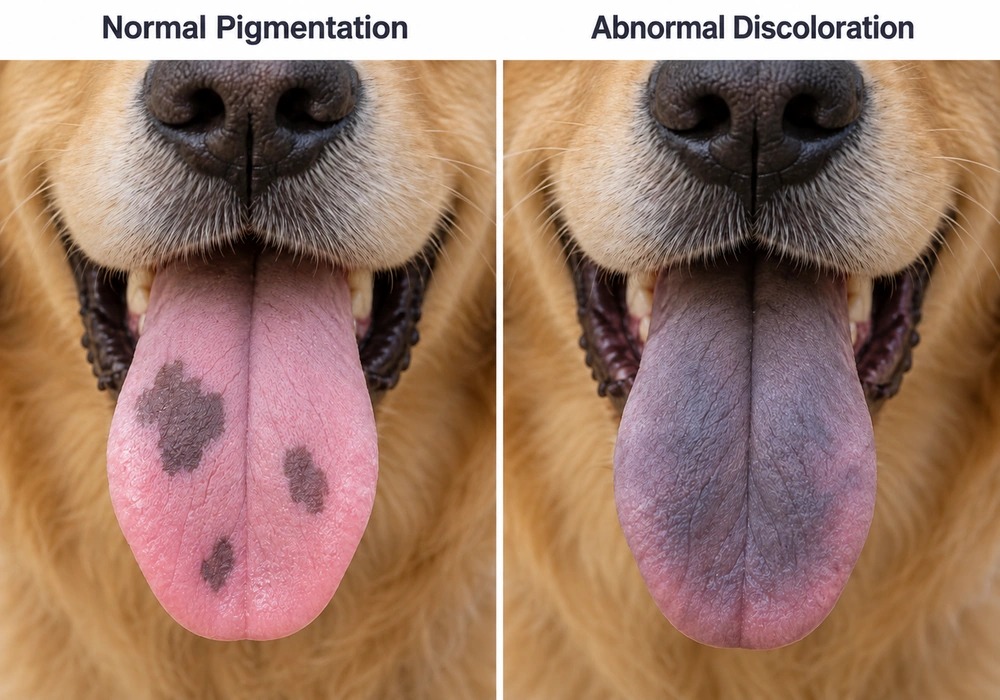
Sometimes the color is normal. Chow Chows and Chinese Shar-Peis are known for blue-black tongues, and dogs of many breeds can have harmless dark spots. Natural pigment should be flat, feel like the surrounding tissue, and stay much the same over time. If you are unsure whether a mark is new, compare it with older photos of your dog.
| Feature | More consistent with normal pigment | Needs veterinary attention |
| History | Present since puppyhood or unchanged for years | Sudden color change or a mark that is growing |
| Distribution | Stable flat patch or typical breed-wide pigmentation | The whole tongue changes or one area becomes irregular |
| Surface | Flat, moist, soft, and similar to nearby tissue | Raised, firm, swollen, ulcerated, bleeding, dry, or sloughing |
| Other signs | Normal eating, breathing, energy, and breath odor | Drooling, bad breath, pain, appetite loss, breathing difficulty, or weakness |
Do not get stuck trying to name the exact shade. Indoor light and phone cameras can make slate grey, blue, dark purple, black, and muddy brown look alike. A better question is whether the color is new and whether the tissue is flat, swollen, sore, or raised. Your dog’s breathing and energy level add more useful information than the color label. For a wider visual overview, see our dog tongue color guide.
What Causes a Grey Tongue in Dogs?
Color alone cannot identify the cause. A veterinarian will also consider breathing, circulation, changes inside the mouth, possible exposure to toxins, and the results of diagnostic tests.
Low blood oxygen
A blocked airway is one possible cause. Pneumonia, fluid in the lungs, chest trauma, a clot in the lungs, or advanced heart and lung disease can also leave the body short of oxygen. The tongue and gums may turn grey, blue, or purple. If your dog is breathing hard, making unusual sounds, coughing, collapsing, or unable to get comfortable, go to an emergency clinic now.
Shock, poor perfusion, or severe anemia
The tongue may look cold, pale, or ashen when too little blood is reaching the mouth. This can happen with major blood loss, severe dehydration, overwhelming infection, heart failure, or another form of shock. The gums may feel tacky as well. With profound anemia, the mouth often looks pale grey rather than blue.
Oxidative poisoning
Some poisons change hemoglobin so that it no longer carries oxygen properly. Acetaminophen is a well-known example, and repeated small exposures can still be dangerous. The tongue or gums may become muddy brown, grey, or blue. Rapid breathing, weakness, vomiting, tremors, or swelling of the face and paws may follow. Never give a dog acetaminophen or another human pain medicine unless a veterinarian prescribed it for that dog.
Foreign body, strangulation, or burn
A strand of thread, a hair tie, or a rubber band can hide beneath the tongue and cut off its blood supply. Electrical burns and caustic chemicals may also leave pale grey or dark tissue that later peels away. Look for swelling, a groove around the tongue, drooling, mouth pain, pawing, or a foul smell. Do not pull on string that disappears under the tongue or into the throat.
Ulcers, inflammation, or kidney disease
Painful ulcers or grey-white material on the tongue can develop with severe dental disease, infection, immune-mediated stomatitis, other inflammation in the mouth, or advanced kidney disease. These dogs often have bad breath and resist having the mouth touched. Bloody drool, poor appetite, vomiting, weight loss, or unusual thirst may also be present.
An oral mass or tumor
Oral tumors do not have one predictable color. A lump may be grey, black, pink-grey, or a mixture, and some tumors contain no dark pigment at all. Arrange a prompt examination for tissue that is raised, firm, growing, ulcerated, or bleeding, particularly if your dog also drools, has bad breath, struggles to eat, or loses weight. A biopsy is usually needed to identify the lesion.
What Can You Check Safely at Home?
Take a quick look only if your dog is calm and breathing comfortably. The goal is to gather useful details for the clinic, not to diagnose the problem at home. Stop immediately if your dog struggles, shows pain, or may bite.
Move into neutral light
Colored lamps, shadows, camera processing, food, and recently chewed toys can alter appearance. Check the tongue and gums in daylight or under a white light if your dog is calm.
Compare more than one area
Look at an unpigmented part of the gums or inner lip as well as the tongue. A widespread change involving several oral surfaces is more concerning than one familiar flat patch.
Observe breathing and circulation
Note open-mouth breathing, noise, effort, posture, weakness, and responsiveness. If breathing is difficult or your dog is collapsing, stop examining the mouth and leave for emergency care.
Note what happened before the change
Tell the clinic when you first noticed the color and whether it covers the whole tongue. Mention recent heat, hard exercise, chewing accidents, medicines, possible toxins, vomiting, or appetite changes. An older photo can help show whether a dark patch was already there.
What not to do
Do not scrub the tongue or apply peroxide or mouthwash. Leave embedded objects and damaged tissue alone, and do not induce vomiting unless a veterinarian or poison service tells you to. Leftover antibiotics and human pain medicines can make matters worse. A home pulse oximeter is not a reliable safety check for dogs because movement, pigment, poor circulation, and device fit can distort the reading.
How Will a Veterinarian Find the Cause?
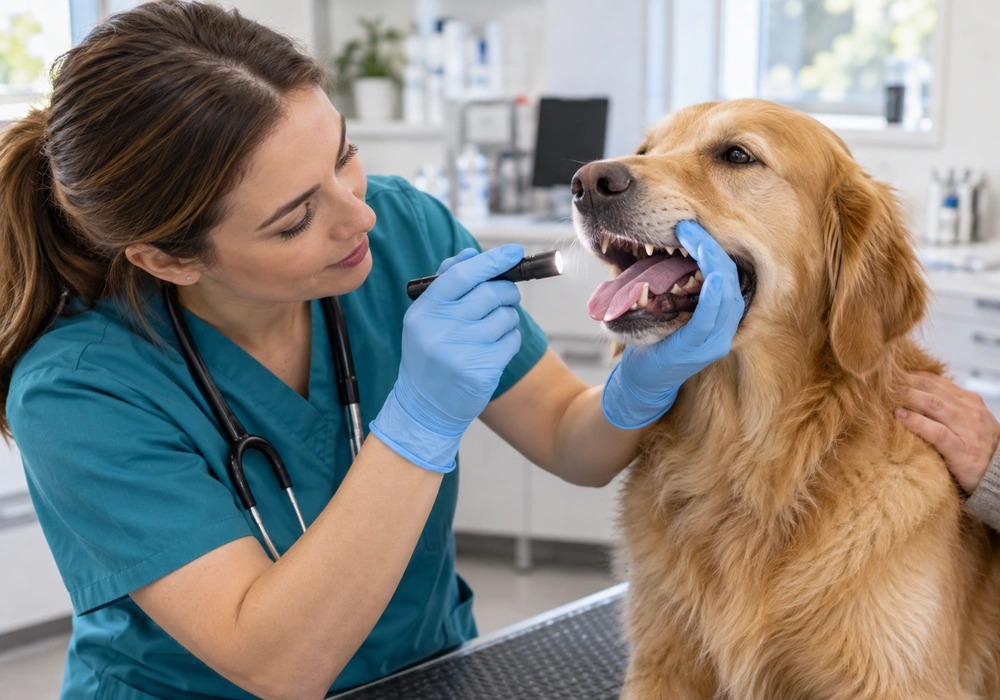
For an unstable dog, the veterinary team will deal with breathing and circulation first. Oxygen, cooling or warming, intravenous access, and airway support may begin before the full examination. Naming the exact shade of grey can wait.
| Evaluation | What it may reveal |
| Physical and oral examination | Breathing pattern, pulse quality, temperature, gum color, swelling, burns, string, ulcers, pain, or a mass |
| Blood tests and blood gas analysis | Anemia, infection, organ dysfunction, acid-base problems, inadequate oxygen, or abnormal hemoglobin |
| Chest imaging | Pneumonia, fluid, trauma, heart enlargement, or another cardiopulmonary cause |
| Sedated oral examination | Hidden foreign material, deep injury, tissue viability, disease under the tongue, or airway abnormalities |
| Cytology or biopsy | The identity of a persistent, raised, ulcerated, or otherwise suspicious lesion |
Treatment follows the cause. Respiratory failure calls for oxygen and airway support. A foreign body wrapped around the tongue may need to be removed under anesthesia, while poisoning requires toxin-specific care. Severe anemia sometimes calls for a transfusion. If the problem is a persistent oral lesion, the next step may be a biopsy and, if cancer is found, staging tests. There is no single treatment for a grey tongue because the color change is a sign, not a diagnosis.
How Soon Does Your Dog Need Care?
Emergency care now
Sudden widespread grey, blue, purple, or muddy color with breathing difficulty, collapse, heat illness, toxin exposure, marked swelling, or a constriction line.
Prompt appointment
A new localized patch, lump, ulcer, bad odor, bleeding, drooling, mouth pain, difficulty eating, or a lesion that changes size, color, or texture.
Document and discuss
A flat, painless, unchanged mark present since puppyhood in a dog that is breathing, eating, and behaving normally. Mention it at routine visits and photograph it for comparison.
Frequently Asked Questions
Is a grey tongue always caused by low oxygen?
No. Natural pigment is one harmless explanation. Poor circulation, severe anemia, abnormal hemoglobin, an oral injury, an ulcer, dead tissue, or a mass can also look grey. A sudden change across most of the tongue, especially with breathing trouble or collapse, is far more concerning for an oxygen or circulation emergency.
Why does my dog have one flat grey or black spot?
Many dogs have harmless pigment spots on the tongue. A mark that has stayed flat, smooth, and painless for years is usually less worrying. Book an examination if it is new or starts to grow, rise above the surface, bleed, or form an ulcer. Bad breath, drooling, and loss of appetite are further reasons to have it checked.
Can dehydration make a dog’s tongue look grey?
Dehydration can make the mouth dry or tacky, and severe dehydration can affect circulation. Even so, do not assume that a truly grey tongue is only a sign of thirst. Grey or pale tissue together with weakness, vomiting, diarrhea, or recent heat exposure needs urgent veterinary advice.
Should I check capillary refill time at home?
You may have seen instructions to press a gum and count how long the color takes to return. Veterinarians use this check as one part of an examination, but it is easy to misread at home. Pigment, lighting, pressure, and technique all affect the result. A result that appears normal should never delay care for a newly grey tongue, abnormal breathing, weakness, or collapse.
Can I wait until morning if my dog seems comfortable?
Call a veterinary clinic whenever a normally pink tongue develops a grey, blue, purple, or muddy-brown color. Do not wait until morning if the change came on suddenly, covers much of the tongue, or appears with abnormal breathing, confusion, weakness, or collapse. A small mark in a dog who otherwise seems well is less likely to be an emergency, but a new mark still deserves an appointment.
The Bottom Line
If the color has always been there and the surface is flat and unchanged, it may simply be your dog’s natural pigment. A new change tells a different story. Sudden discoloration, swelling, pain, bleeding, or a raised area needs veterinary attention. If your dog is struggling to breathe, weak, confused, or collapsing, leave for emergency care immediately.
Veterinary references
- Merck Veterinary Manual: Initial Triage and Resuscitation of Small Animal Emergency Patients
- Merck Veterinary Manual: Clinical Signs of Respiratory Disease in Animals
- Merck Veterinary Manual: Soft Tissue Trauma of the Mouth in Small Animals
- Merck Veterinary Manual: Oral Tumors in Small Animals
- Merck Veterinary Manual: Toxicoses From Human Analgesics in Animals
- American Kennel Club: Dog Breeds With Blue Tongues and What They Mean
This article provides general educational information and does not replace an examination by a veterinarian.
Related Articles
7 Fun Games for Dog Mental Stimulation
Mental stimulation for dogs is play and problem-solving that works the brain instead of just the legs: scent games, puzzle toys, hidden treats, new tricks. A physically tired dog can
Why Is My Dog’s Tongue Grey?
Canine oral health and emergency triage Why Is My Dog's Tongue Grey? A grey tongue in dogs does not always mean the same thing. Some dogs are born with dark

How to Identify Canine Hormone Imbalance Symptoms
Canine endocrine health How to Identify Canine Hormone Imbalance Symptoms Hormones influence a dog's metabolism, appetite, thirst, skin, coat, muscles, stress response, blood sugar, and reproductive cycle. Most endocrine disorders