
● Monitor
Stable pink tissue or lifelong dark pigmentation
● Call Your Vet
Persistent yellow tissue or a changing dark spot
● Emergency Care
Blue, gray, purple, or suddenly white tissue
Quick answer: Tongue color alone cannot diagnose your dog. Compare it with your dog’s normal appearance and consider the gums, breathing, behavior, temperature, and accompanying symptoms. A blue, gray, purple, or suddenly white tongue—particularly with breathing difficulty, weakness, or collapse—is an emergency.
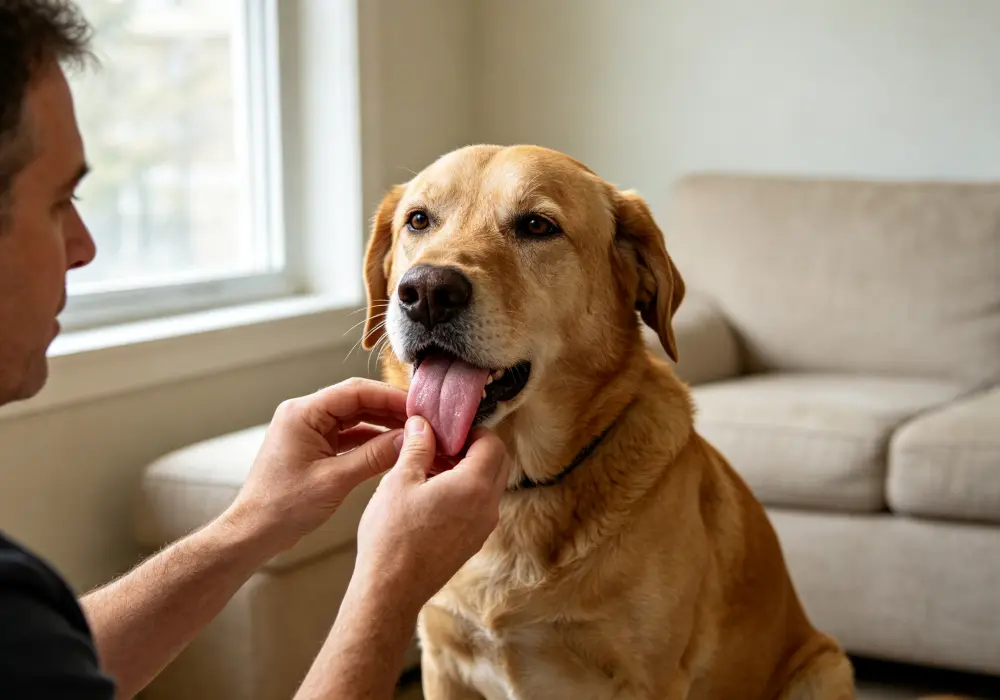
⚠ Emergency warning
Seek emergency veterinary care if your dog has a blue, gray, purple, or very pale tongue together with labored breathing, choking, collapse, severe weakness, uncontrolled bleeding, facial swelling, seizures, or reduced responsiveness. Do not wait for the color to improve on its own.
In this guide
Dog tongue color chart: six colors at a glance
Use this chart as a first-look guide rather than a diagnostic test. Lighting, natural pigmentation, recent activity, food, medication, and surface staining can all affect what you see.
| Tongue color | What it may indicate | Recommended response | Urgency |
|---|---|---|---|
|
Pink |
Usually normal when moist and accompanied by normal behavior. | Learn your dog’s baseline and monitor changes. | Usually normal |
|
Pale or white |
Possible anemia, blood loss, shock, or poor circulation. | Contact a veterinarian promptly; seek emergency care if sudden. | Potential emergency |
|
Blue, gray, purple |
Possible inadequate oxygen, choking, heart disease, or respiratory trouble. | Go to an emergency veterinary hospital immediately. | Emergency |
|
Bright red |
Possible overheating, heatstroke, inflammation, or toxin exposure. | Remove your dog from heat and contact a veterinarian. | Urgent |
|
Yellow |
Possible jaundice involving the liver, bile system, or red blood cells. | Arrange a veterinary examination promptly. | Needs evaluation |
|
Black or spotted |
Often normal inherited pigmentation if stable and lifelong. | Have new, raised, bleeding, or changing areas examined. | Often normal |
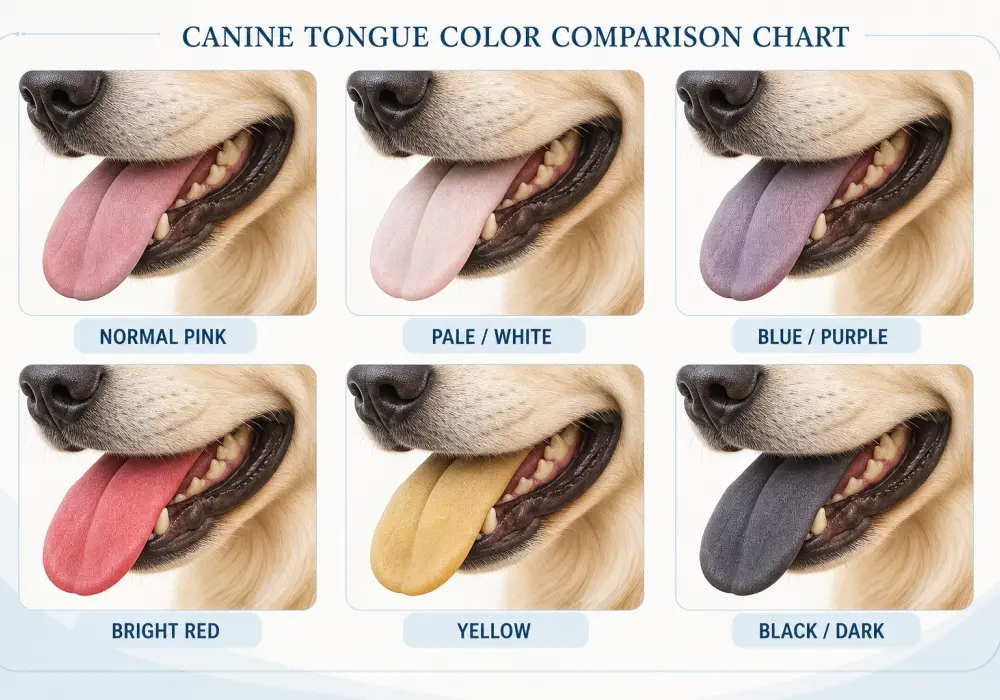
Important: A photograph or color chart cannot account for every dog, lighting condition, or illness. Contact a veterinarian if the color change is sudden, widespread, persistent, or accompanied by abnormal behavior.
1. Pink tongue: usually a healthy baseline
What a normal pink tongue looks like
For many dogs, a healthy tongue is light to medium pink and slightly moist. The gums are often a similar shade. Your dog should also be alert, breathing comfortably, and behaving normally.
The exact shade varies. A tongue may look temporarily darker after exercise because blood flow increases, but it should return toward its normal color after the dog rests and cools down.
Learn your own dog’s baseline instead of trying to match a photograph exactly. Checking the tongue and gums while your dog is healthy gives you a useful reference for future changes.
2. Pale or white tongue
What it may mean
A tongue that is noticeably paler than normal may be associated with anemia, blood loss, poor circulation, shock, or another illness affecting blood flow or red blood cells.
Possible accompanying signs include:
- Weakness or unusual tiredness
- Rapid breathing or a fast heartbeat
- Cold feet or ears
- A swollen or painful abdomen
- Black stool, vomiting blood, or visible bleeding
- Collapse or difficulty standing
⚠ When pale becomes urgent
If the tongue suddenly turns white or extremely pale—especially with weakness, bleeding, breathing difficulty, abdominal swelling, or collapse—seek emergency veterinary care.
3. Blue, gray, or purple tongue
A possible sign of inadequate oxygen
Blue, gray, or purple discoloration can indicate cyanosis, meaning the tissues may not be receiving enough oxygenated blood. Possible causes include airway obstruction, severe respiratory disease, heart problems, smoke inhalation, or choking.
Warning signs may include noisy or labored breathing, stretching the neck to breathe, open-mouth breathing unrelated to normal panting, weakness, confusion, or collapse.
⚠ Do not monitor this color at home
A newly blue, gray, or purple tongue should be treated as an emergency. Keep your dog calm, minimize handling, and travel to the nearest emergency veterinary hospital.
4. Bright red or brick-red tongue
Heat and inflammation are important concerns
A tongue can temporarily look darker after exercise. However, an unusually bright or brick-red tongue accompanied by heavy panting, drooling, weakness, vomiting, confusion, or collapse can be associated with heatstroke.
Other possible explanations include oral inflammation, fever, irritation, toxin exposure, or a reaction that increases blood flow. Interpret the color alongside your dog’s environment, breathing, temperature, and behavior.
✓ If overheating is possible: Move your dog into shade or air conditioning, begin cooling with cool—not ice-cold—water, and contact a veterinarian immediately.
Read our related guide to dog heatstroke symptoms and warning signs.
5. Yellow tongue or yellow oral tissues
Look beyond the tongue
Surface staining can make the tongue look yellow. However, yellow discoloration of the gums, whites of the eyes, or skin can indicate jaundice involving the liver, bile system, or abnormal destruction of red blood cells.
Arrange veterinary care if yellow tissue occurs with loss of appetite, vomiting, diarrhea, dark urine, pale stool, weight loss, abdominal discomfort, weakness, or reduced energy.
6. Black, blue-black, or spotted tongue
Natural pigmentation can be normal
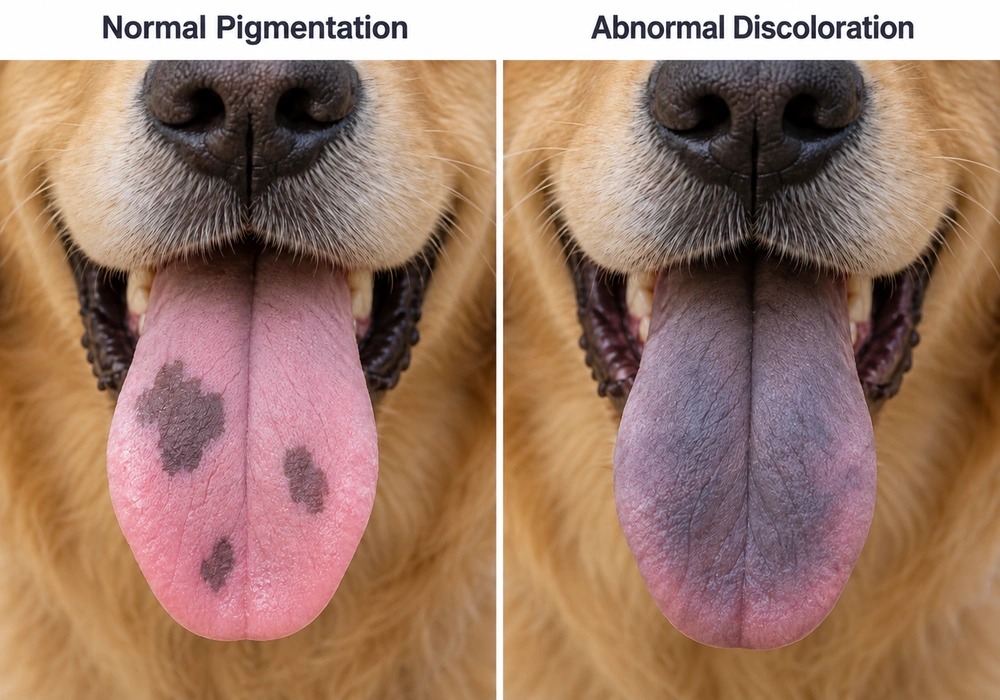
Many dogs have harmless black or blue-black spots on the tongue. If the pigmentation has been present for years, remains flat, and does not change, it is often normal.
Ask a veterinarian to examine an area that appears suddenly, grows, changes shape, becomes raised or painful, bleeds, develops an ulcer, or interferes with eating.
Natural pigment versus oxygen trouble: Stable, clearly defined dark spots differ from a sudden diffuse blue, gray, or purple change across the tongue and gums.
How to check your dog’s tongue safely
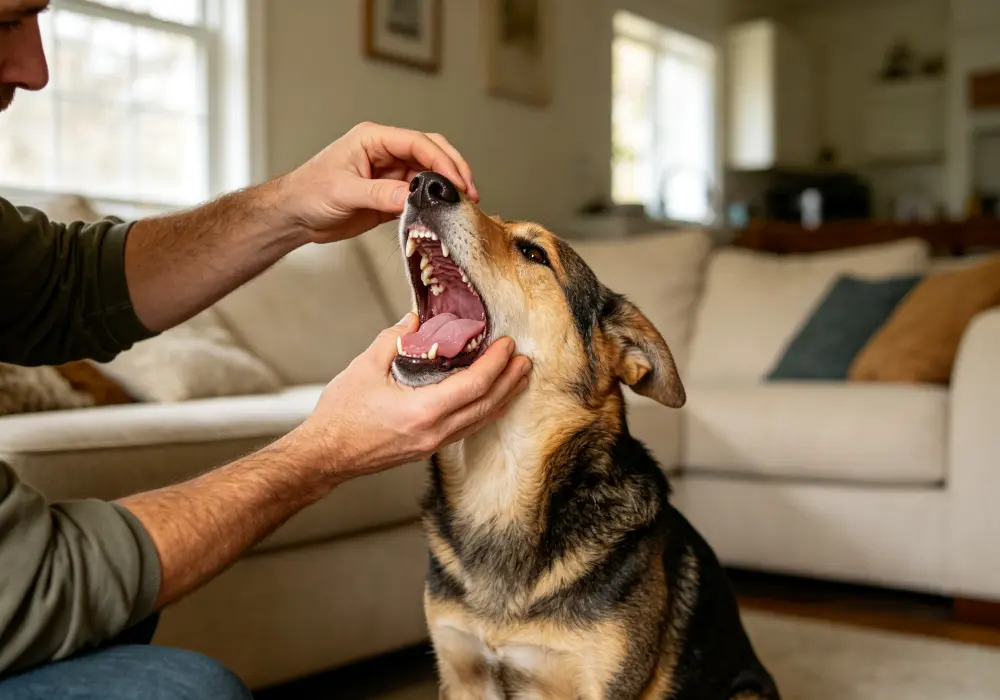
1Choose a calm moment
Check your dog while they are relaxed and breathing normally. Do not put your hands near the mouth of a frightened, painful, or disoriented dog.
2Use natural light
Colored indoor lighting, shadows, and phone filters can distort pink, yellow, blue, and gray tones.
3Lift the lip gently
Look at the tongue and gums without forcing the mouth open. Stop if your dog becomes stressed or attempts to bite.
4Compare several areas
Determine whether the change affects one small spot or appears across the tongue, gums, and inner lips.
5Check moisture and texture
Notice whether the tissues are moist, dry, sticky, swollen, ulcerated, bleeding, or covered by a removable stain.
6Assess the whole dog
Observe breathing, energy, balance, appetite, heat exposure, vomiting, pain, coughing, and possible toxin contact.
Can you use the capillary refill test?
Capillary refill time is checked by gently pressing a non-pigmented area of gum until it lightens, then releasing and watching the color return. Veterinarians use it as one part of a circulation assessment.
A commonly used reference is approximately one to two seconds. However, technique, lighting, gum pigmentation, illness, and observer judgment can affect the result. A study involving 111 hospitalized dogs reported a median capillary refill time of 1.1 seconds.
Do not rely on this test to rule out an emergency. If your dog is struggling to breathe, collapsing, bleeding, or showing a sudden abnormal tongue color, seek veterinary help regardless of the refill time.
Factors that can make tongue color misleading
- Natural pigmentation: Stable black or blue-black spots may be normal.
- Lighting: Warm bulbs may create a yellow or red cast; cool lights may make tissues look blue.
- Recent exercise: Increased blood flow can temporarily deepen the pink color.
- Food and toys: Dyes, berries, dirt, ink, and colored chews may leave surface stains.
- Dehydration: The tongue and gums may feel dry or sticky.
- Medications: Some products can affect saliva, tissue appearance, or behavior.
- Photography: Camera processing and screen settings may alter colors.
When should you call a veterinarian?
Seek emergency veterinary care immediately for:
- Blue, gray, or purple tongue or gums
- Suddenly white or extremely pale tissue
- Difficulty breathing or choking
- Collapse or reduced responsiveness
- Bright-red tongue after heat exposure
- Uncontrolled or suspected internal bleeding
- Facial or throat swelling
- Seizures or suspected poisoning
Arrange a prompt appointment for persistent yellow tissues, a new or changing dark lesion, mouth pain, repeated drooling, difficulty eating, continuing bad breath, unexplained fatigue, or any change that does not return to your dog’s normal baseline.
Frequently asked questions
What color should a healthy dog’s tongue be?
Most healthy dogs have a moist pink tongue. Some dogs naturally have black or blue-black pigmentation. Your dog’s normal appearance is the most useful baseline.
Why is my dog’s tongue purple?
Some dogs have lifelong purple-black pigmentation. A sudden widespread purple, blue, or gray change may indicate inadequate oxygen and should be treated as an emergency.
Does a pale tongue always mean anemia?
No. Anemia is one possible cause, but blood loss, shock, poor circulation, and other illnesses can also make oral tissues look pale.
Can heat make a dog’s tongue bright red?
Yes. A brick-red tongue combined with heavy panting, drooling, weakness, vomiting, confusion, or collapse may indicate heatstroke.
Are black spots on a dog’s tongue normal?
Flat, stable dark spots are often normal pigmentation. A veterinarian should examine any area that is new, growing, raised, painful, ulcerated, or bleeding.
Can I diagnose my dog from tongue color alone?
No. Tongue color is only one observation. Diagnosis may require a physical examination, vital signs, blood tests, imaging, or other veterinary testing.
Final takeaway
A dog tongue color chart can help you recognize meaningful changes, but it cannot identify the exact cause. Learn your dog’s normal appearance, check the mouth in reliable lighting, and consider the whole dog rather than color alone.
Stable pink tissue and lifelong dark pigmentation are often normal. Sudden blue, gray, purple, very pale, bright red, or yellow discoloration deserves closer attention. Treat color changes accompanied by breathing difficulty, collapse, extreme weakness, or heatstroke symptoms as an emergency.
Sources and further reading
Related Articles

7 Fun Games for Dog Mental Stimulation
Mental stimulation for dogs is play and problem-solving that works the brain instead of just the legs: scent games, puzzle toys, hidden treats, new tricks. A physically tired dog can
Why Is My Dog’s Tongue Grey?
Canine oral health and emergency triage Why Is My Dog's Tongue Grey? A grey tongue in dogs does not always mean the same thing. Some dogs are born with dark

How to Identify Canine Hormone Imbalance Symptoms
Canine endocrine health How to Identify Canine Hormone Imbalance Symptoms Hormones influence a dog's metabolism, appetite, thirst, skin, coat, muscles, stress response, blood sugar, and reproductive cycle. Most endocrine disorders