
Great Dane Heart Rate: Normal Range and Warning Signs
Put your fingers on a sleeping Great Dane’s pulse and it may feel surprisingly slow. That can be normal. The useful question is not whether one reading matches a chart exactly, but whether it fits this dog’s usual resting pattern and how the dog looks at the time.
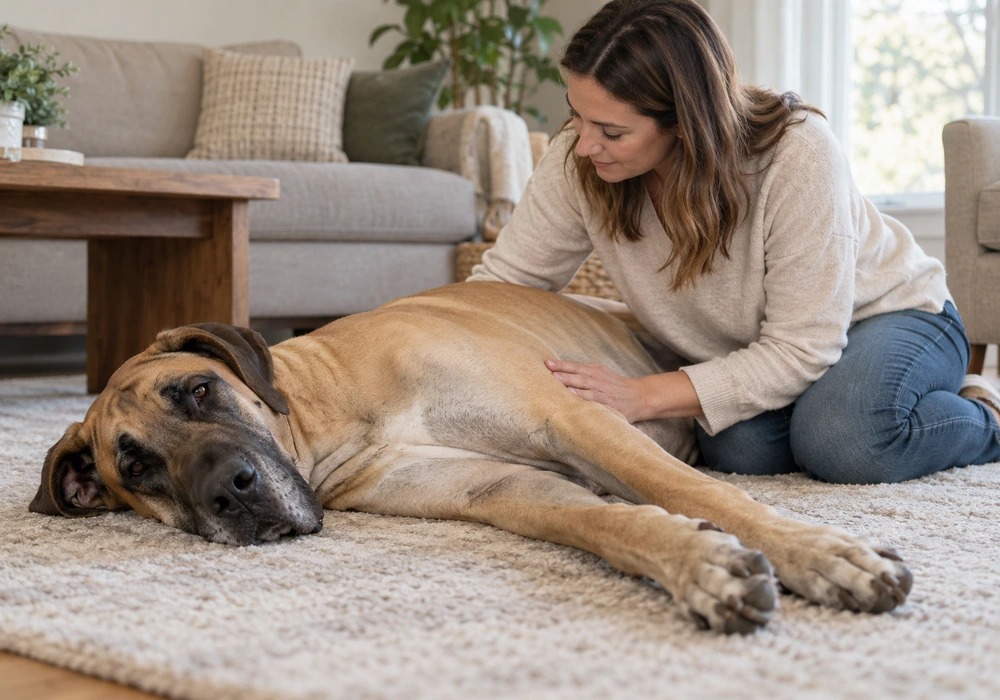
What Is a Normal Heart Rate for a Great Dane?
No veterinary reference offers one Great Dane-only interval that suits every dog. The Merck Veterinary Manual gives 70 to 120 bpm for dogs in general and notes that larger dogs tend to run slower. Its emergency triage table uses 60 to 120 bpm for large dogs. A relaxed Great Dane at home often lands near the lower end.
So 60 and 100 are not pass-fail lines. A comfortable dog with a steady pulse of 58 bpm may be deeply relaxed. Another dog at 95 bpm could need urgent care if the pulses are weak and breathing is labored. The number makes sense only when paired with the dog in front of you.
| Situation | What you may observe | How to interpret it |
|---|---|---|
| Calm adult at home | Often toward the lower end of the 60-120 bpm large-dog reference | Record several quiet readings to establish an individual baseline. |
| Sleeping deeply | May be lower than the awake rate and may vary with breathing | Reassuring only when breathing is easy, gums look normal and the dog wakes normally. |
| Great Dane puppy | Usually faster than an adult | Age and excitement have a strong effect. Use a puppy-specific reference and ask your veterinarian about persistent extremes. |
| Veterinary clinic | Often higher than the home baseline | Travel, handling and anxiety can cause temporary sinus tachycardia. |
| After exercise or excitement | Temporarily elevated | The rate should trend downward as the dog cools and settles. |
How to Measure Your Great Dane’s Heart Rate
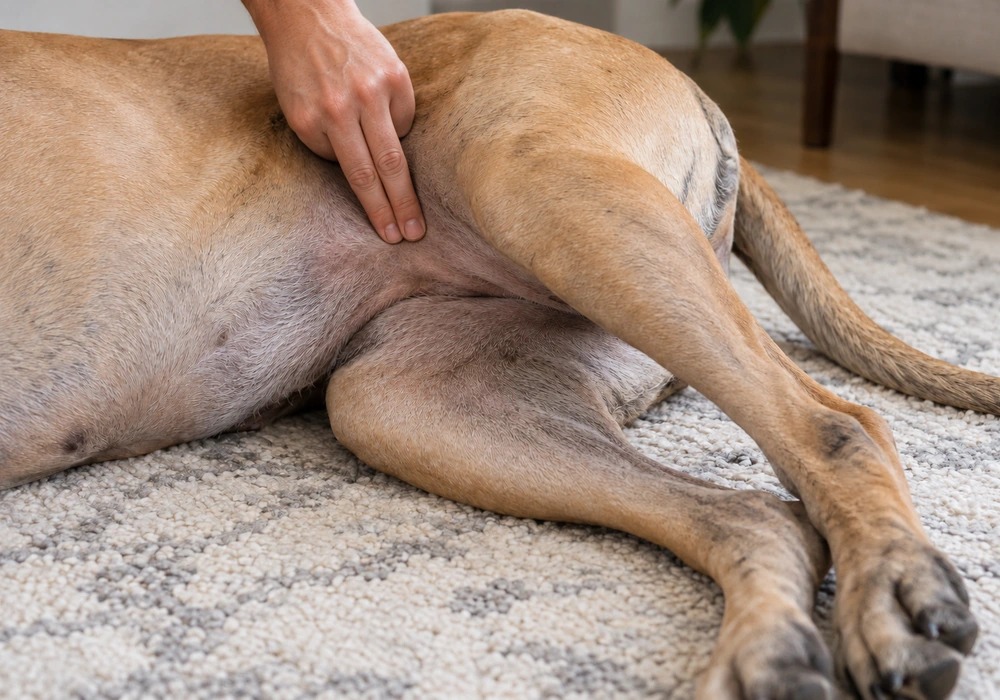
A Great Dane’s deep chest can make the heartbeat awkward to find at first. Try the chest or the femoral pulse inside the upper rear leg. Practice on an ordinary quiet evening. The first attempt should not be happening while you are frightened and deciding whether to call an emergency clinic.
Rate, Rhythm and Pulse Strength Tell Different Stories
A faster pulse
Exercise, heat, anxiety, pain and fever can all raise the rate. A pulse that remains fast after quiet rest can also accompany dehydration, anemia, infection, blood loss, heart failure or an abnormal rhythm.
A slower pulse
Deep sleep and good conditioning may lower the rate. A newly slow pulse with weakness, confusion, fainting or poor pulses can occur with conduction disease, electrolyte disturbances, hypothermia or serious systemic illness.
An irregular rhythm
Dogs commonly have respiratory sinus arrhythmia: the pulse speeds with inhalation and slows with exhalation. A persistently chaotic rhythm, frequent premature beats or pulse deficits cannot be identified reliably by touch alone and needs an ECG.
A delayed recovery
After ordinary activity, the pulse should steadily fall as your dog rests. A dog that remains exhausted, breathless or markedly tachycardic after stopping needs veterinary advice, especially if this pattern is new.
Now look away from the timer. Is your dog alert? Are the gums their usual color? Is the chest moving without effort? The dog temperature chart and dog gum color guide can help you describe what you see when you call the clinic.
Why Heart Monitoring Matters in Great Danes
Dilated cardiomyopathy
Great Danes are predisposed to dilated cardiomyopathy, or DCM. The heart muscle weakens, the chambers enlarge and pumping becomes less effective. Early DCM can be silent. A dog may look well and still have changes that show up on an echocardiogram or rhythm recording.
Later signs include less stamina, weakness, weight loss, coughing, harder breathing, abdominal swelling or collapse. Abnormal atrial or ventricular rhythms may appear too. A home pulse count can flag a change, but it cannot diagnose or rule out DCM.
Atrial fibrillation and other arrhythmias
Great Danes can develop atrial fibrillation. The pulse may be fast and completely uneven, with some heartbeats too weak to create a clear pulse in the rear leg. Touch cannot name the rhythm. That takes an ECG. An echocardiogram checks the heart’s structure, while a Holter monitor records what happens during a normal day and night.
Gastric dilatation-volvulus can affect circulation
Great Danes also have a high risk of gastric dilatation-volvulus (GDV), often called bloat. The swollen, twisted stomach can impair circulation and trigger shock or arrhythmias. Pacing, repeated attempts to vomit without producing anything, heavy drooling or a growing abdomen are enough reason to leave for an emergency clinic. Do not stay home counting the pulse.
When an Abnormal Heart Rate Is an Emergency
- collapse, fainting, inability to stand or sudden profound weakness
- labored breathing, open-mouth breathing at rest or a blue-gray tongue or gums
- very pale or white gums, cold limbs or weak and difficult-to-find pulses
- a swollen abdomen, repeated dry heaving, drooling or frantic pacing
- an extremely rapid, chaotic rhythm or a very slow rhythm with reduced responsiveness
- coughing with pink foam or rapidly worsening breathing effort
A reading just outside a chart is not automatically an emergency in a bright, comfortable dog. But a number inside the range does not make collapse or difficult breathing safe. In that moment, put down the timer and go.
How Veterinarians Evaluate an Abnormal Great Dane Heart Rate
The appointment usually starts with a simple comparison: the veterinarian listens to the heart while feeling a pulse in the leg. A heartbeat that does not produce a matching pulse is useful information. The exam may also find a murmur, an uneven rhythm or poor circulation. Testing then depends on what the veterinarian hears and feels.
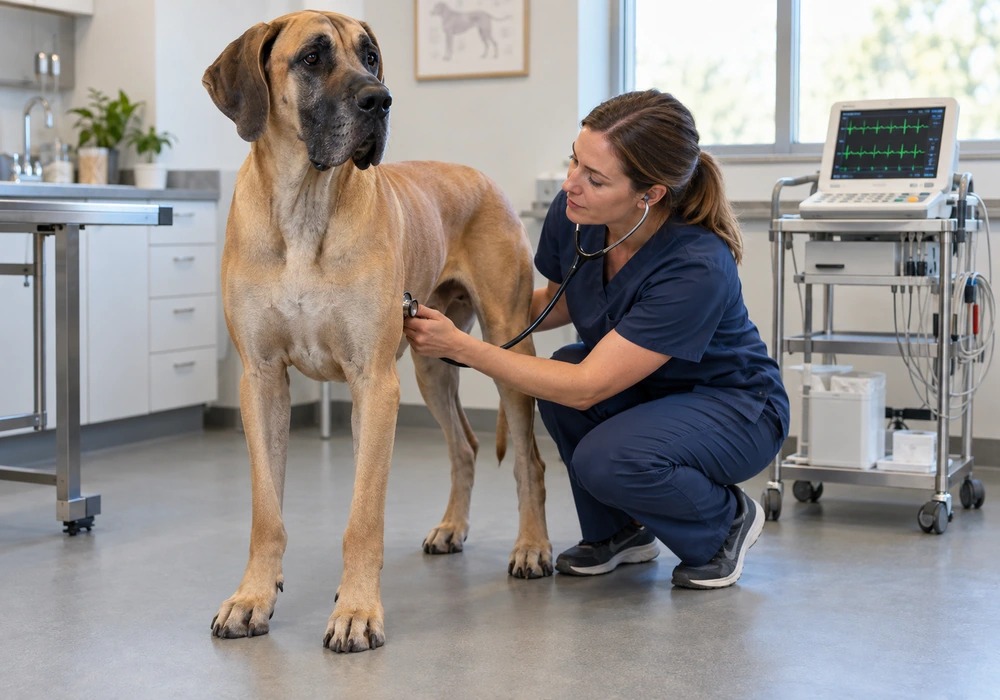
- Electrocardiogram: identifies the electrical rhythm during the recording.
- Holter monitor: records an ECG for 24 hours or longer to catch intermittent abnormalities and measure the average rate.
- Echocardiogram: evaluates chamber size, valves and pumping function; it is central to diagnosing DCM.
- Chest radiographs: assess heart silhouette and look for fluid or other lung changes.
- Blood pressure and blood tests: look for poor perfusion, anemia, electrolyte changes and non-cardiac causes of an abnormal rate.
There is no single screening schedule for every Great Dane. Ask your veterinarian to base it on age, family history, symptoms and examination findings. If the dog will be bred, say so. Our guide to signs of congestive heart disease in dogs covers the changes owners often notice at home.
Build a Useful Home Baseline
Check two or three times a week for several weeks, always when your dog is calm. That tells you far more than ten anxious counts in one evening. Bring the log to appointments; a short video of unusual chest movement or an episode of weakness can help too.
| Date and time | State | Heart rate | Rhythm and pulse | Sleeping breaths | Notes |
|---|---|---|---|---|---|
| Example: Monday, 9 pm | Awake, lying quietly | 72 bpm | Regular, strong | 18/min | No cough; normal walk |
| Your reading | |||||
| Your reading |
Frequently Asked Questions
What is a normal resting heart rate for a Great Dane?
Many calm adult Great Danes fall near the lower end of the large-dog reference range. About 60 to 100 bpm is a practical home guide, while veterinary references may use 60 to 120 bpm for large dogs. Your dog’s repeatable baseline, rhythm, pulse strength and symptoms are more important than one exact cutoff.
Can a sleeping Great Dane have a heart rate below 60 bpm?
Yes. Sleep and strong vagal tone can lower a healthy dog’s rate. A lower sleeping value is more reassuring when the rhythm and pulses are strong, breathing is easy, gum color is normal and the dog wakes and behaves normally. A newly slow pulse with weakness or collapse needs prompt evaluation.
Why does my Great Dane’s pulse speed up and slow down?
Respiratory sinus arrhythmia is common in dogs: the rate rises during inhalation and falls during exhalation. It can be normal at rest. A chaotic rhythm, frequent extra beats, missing pulses, fainting or weakness should be assessed with an ECG.
How long should I count my dog’s pulse?
Count a steady pulse for 30 seconds and multiply by two. Count for a full 60 seconds if the rhythm is irregular, the rate is unusually slow, or you are concerned. The longer count reduces errors caused by brief pauses and normal respiratory variation.
Can I diagnose DCM from my Great Dane’s heart rate?
No. Dogs with early DCM may have a seemingly normal rate and no outward signs. Diagnosis and screening can involve examination, echocardiography, ECG, Holter monitoring, radiographs and blood work.
Veterinary references
- Merck Veterinary Manual: Normal Physiological Values for Dogs
- Merck Veterinary Manual: Parameters to Evaluate During Triage
- Cornell University College of Veterinary Medicine: Dilated Cardiomyopathy
- VCA Animal Hospitals: Home Breathing Rate Evaluation
- Great Dane Club of America: Health and Research
This article supports home observation and is not a diagnosis. Contact a veterinarian about readings or symptoms that concern you.
Related Articles
Great Dane Heart Rate: Normal Range and Warning Signs
Great Dane cardiac health Great Dane Heart Rate: Normal Range and Warning Signs Put your fingers on a sleeping Great Dane's pulse and it may feel surprisingly slow. That can
Why Is My Old Dog Suddenly Not Eating
Senior dog appetite guide Why Is My Old Dog Suddenly Not Eating? A skipped meal is not always a crisis. Still, when an older dog suddenly walks away from food,
Why Does My Dog Cough at Night?
Nighttime cough guide Why Does My Dog Cough at Night? A dog may cough at night because the bedroom air is irritating an already sensitive throat. Repeated episodes can also