
A newborn puppy’s heart beats 160 to 220 times per minute, or between two and three beats every second. By two to six months that settles into 120 to 160 bpm, and it keeps falling until adulthood.
If you are comparing your puppy to the adult range of 60 to 140 bpm, a completely healthy puppy looks dangerously fast. That single mistake is the most common reason owners panic. Less often, it is also the reason a genuinely sick puppy gets missed.
Below you will find the resting ranges by age and breed size, plus how to count the beats without the errors that plague short counts. The last sections sort out which numbers mean “keep watching” and which mean “call a vet now.”
Quick answer: Count while your puppy is calm and has rested 15 to 30 minutes. Use the age chart below, not the adult range. A rate that stays above 220 bpm at rest needs a same-day vet call, and in a puppy under four weeks a rate below 140 bpm is an emergency.
In this guide

Puppy Heart Rate Chart by Age
Puppy heart rates follow a predictable downward path from birth to maturity. Every range below is a resting rate, measured when your puppy is calm, awake, and has been lying quietly for at least 15 to 30 minutes.
| Life stage | Age | Resting heart rate | What is happening internally |
|---|---|---|---|
| Fetal (in the womb) | Late pregnancy, over 55 days | 230 – 250 bpm | Used as a viability measure; below 180 signals fetal distress |
| Early neonatal | 0 – 2 weeks | 160 – 220 bpm (median ~200) |
Blood flow depends entirely on rate; the heart-slowing system is not working yet; rhythm is steady with no variation |
| Late neonatal | 2 – 8 weeks | 140 – 200 bpm (median ~170) |
The braking system starts to develop; growth demands stay high |
| Juvenile | 2 – 6 months (8 – 24 weeks) |
90 – 180 bpm varies by breed size |
Breed size begins to matter; the heart muscle is maturing |
| Adolescent | 6 – 12 months | 70 – 160 bpm varies by breed size |
Autonomic balance established; breathing-linked rhythm variation appears |
| Adult (reference) | Over 12 months | 50 – 160 bpm size-dependent |
Small breeds stay fast, giant breeds run slow |
For adult dogs of every size, see our full dog heart rate chart.
Puppy Heart Rate by Breed Size
For the first eight weeks, breed does not matter. A Chihuahua neonate and a Great Dane neonate both run 160 to 220 bpm, because at that size every puppy’s heart is working near its structural ceiling.
Between two and six months, size starts to separate them. This follows a scaling pattern seen across all mammals: smaller bodies burn more energy per unit of weight, so smaller hearts must beat faster to supply them.
| Expected adult size | Examples | Puppy 2–6 months |
Adolescent 6–12 months |
Adult |
|---|---|---|---|---|
| Toy (under 12 lb / 5.5 kg) | Chihuahua, Yorkshire Terrier | 140 – 180 | 120 – 160 | 100 – 160 |
| Small (12–25 lb / 5.5–11.5 kg) | Shih Tzu, Miniature Poodle | 130 – 170 | 100 – 140 | 90 – 140 |
| Medium (25–50 lb / 11.5–23 kg) | Beagle, Border Collie | 120 – 160 | 90 – 130 | 70 – 120 |
| Large (50–90 lb / 23–41 kg) | Labrador, German Shepherd | 100 – 140 | 80 – 110 | 60 – 100 |
| Giant (over 90 lb / 41 kg) | Great Dane, Mastiff | 90 – 130 | 70 – 100 | 50 – 90 |
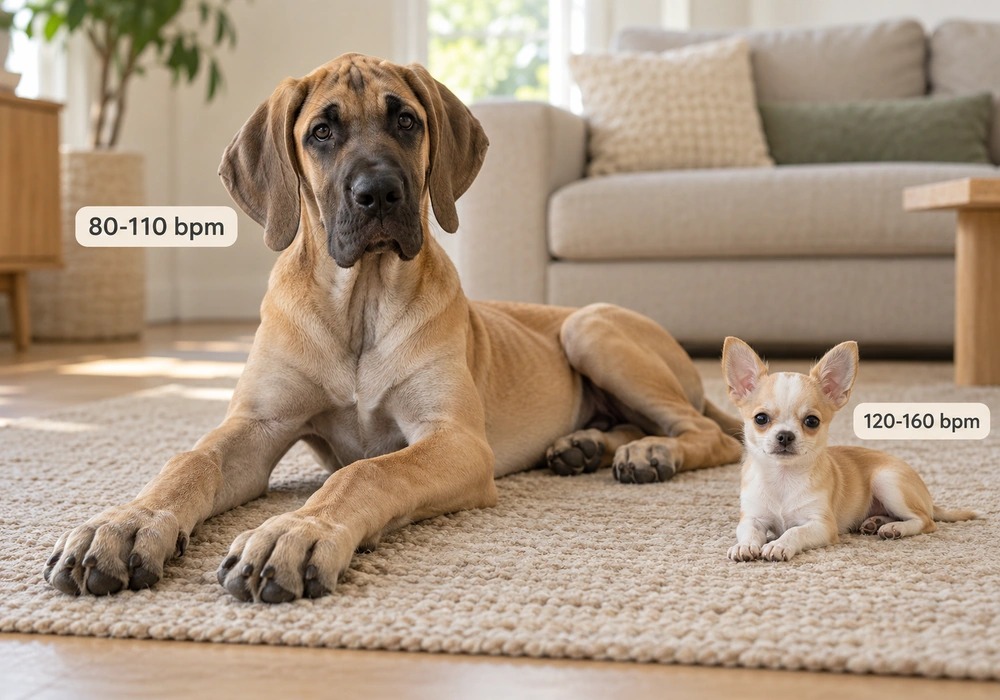
By six months the two look nothing alike. A Great Dane puppy trends toward 80 to 110 bpm, while a Chihuahua puppy the same age stays in the 120 to 160 range. Neither is abnormal. Both are where they should be.
Why a Puppy’s Heart Beats So Much Faster Than an Adult Dog’s
A puppy is not a small adult dog. Cardiovascularly the two work differently, and that difference explains almost every number in the tables above.
The heart cannot pump harder, only faster
A newborn’s heart muscle is structurally immature. It has proportionally less contractile tissue, disorganized internal fiber architecture, rudimentary tubule networks, and an underdeveloped calcium storage system.
The practical result: a puppy’s heart cannot increase the volume of blood it moves per beat the way an adult heart can. The left ventricle is already operating near its maximum stretch, with little compliance left in reserve.
Why rate is everything
Blood flow = heart rate × volume per beat
When that volume is effectively fixed, everything depends on rate. If the rate drops, blood flow, blood pressure, and tissue oxygen delivery all drop immediately and proportionally. There is no backup mechanism.
This is why a slow heart rate in a puppy is far more alarming than the same number in an adult. In an adult dog, a slow resting rate usually signals good fitness. In a puppy under four weeks, a rate below 140 bpm can mean the body is failing.
Growth demands more oxygen
Young puppies also consume far more oxygen per unit of body weight than adults, because building tissue is metabolically expensive. That alone requires a higher cardiac output relative to body size, which pushes the resting rate up further.
The brake has not been installed yet
At birth, the accelerating side of the nervous system is fully functional. The branch that slows the heart, the vagal system, is not.
The heart’s natural pacemaker therefore fires without any inhibitory damping. This produces two things owners often notice:
- The rhythm stays steady, with no rise and fall in time with breathing. In puppies under about 20 weeks that is normal rather than a warning sign.
- Rates stay high. Anything above 120 bpm suppresses the small variations the vagal system would otherwise produce.
That braking system matures gradually between roughly 8 and 24 weeks. As it comes online, resting rates fall and a breathing-linked rhythm variation appears for the first time. Seeing that variation develop is actually a reassuring sign of normal maturation.
How to Check Your Puppy’s Heart Rate at Home
You do not need a stethoscope. Placing your hand on the chest works well for a calm puppy, and it is the method veterinary references recommend for owners.
Position your puppy
Your puppy should be standing or lying quietly, either on their side or on their chest. Do not try this while they are being held upright, wriggling, or right after play.
Find the right spot
Place the flat palm-side surface of your fingers against the left side of the chest, just behind the point of the elbow. This sits at the fourth to fifth space between the ribs.
The spot matters. It is where the bottom tip of the left ventricle presses closest to the chest wall, the point of maximal intensity, where the beat is strongest and easiest to count.
Count the pair as one beat
Each heartbeat is actually a pair of sounds, the familiar “lub-dub.” The first is the upper chambers’ valves closing, the second is the outflow valves closing.
Count the pair as a single beat. Counting each sound separately will double your number and send you into a panic about a perfectly healthy puppy. This is the most common counting error there is.
How long to count, and why it matters more for puppies
With adult dogs, people commonly count for 15 seconds and multiply by four. For a puppy, that shortcut introduces real, quantifiable error.
A young puppy’s heart beats between 2.5 and 3.5 times every second. Miscounting by just two beats over a 15-second window throws your result off by roughly 8 bpm. On a target range that may only be 40 bpm wide, that is a fifth of your entire margin consumed by counting error.
A short count has a second problem: if your puppy shifts, whines, or gets excited partway through, a 15-second window can capture a temporary stress spike and report it as their resting rate.
Use these rules instead:
| Situation | Count for |
|---|---|
| Calm puppy, steady regular rhythm | 30 seconds, ×2 |
| Neonate under 4 weeks old | Full 60 seconds |
| Rhythm feels irregular | Full 60 seconds |
| You suspect the rate is too fast or too slow | Full 60 seconds |
| You are deciding whether to seek emergency care | Full 60 seconds |
When the answer determines whether you drive to an emergency clinic, do not extrapolate from a short count.
The pulse check that catches more than listening alone
If you want to be thorough, feel the pulse in the hind leg at the same time as you count the chest. Vets do this routinely.
The femoral artery runs along the inner side of the hind leg, in the upper thigh. Press lightly and steadily with the pads of your index and middle fingers, rolling the artery gently against the bone beneath.
Never use your thumb. Your thumb has its own prominent artery, and you will end up counting your own pulse instead of your puppy’s.
Every heartbeat you feel at the chest should produce a matching pulse at the leg. When a heartbeat fails to produce one, that beat did not move enough blood to reach the periphery. This is called a pulse deficit.
In a puppy, a pulse deficit points to an electrical or mechanical problem, typically premature ventricular contractions or a more advanced conduction disturbance. That is a reason to call your vet rather than keep monitoring at home.
What Changes a Puppy’s Heart Rate Temporarily
A single high reading usually means nothing. Isolating a true resting baseline means accounting for these factors.
| Factor | Typical effect |
|---|---|
| Deep (non-REM) sleep | Drops the rate 15% to 30% below the awake resting baseline |
| Dream (REM) sleep | Causes episodic surges, faster breathing, whimpering, and twitching of whiskers and paws. All normal. |
| Play, exercise, excitement, fear | Adds 40 to 50 bpm; a 10-week-old can jump from 130 at rest to 200–240 bpm |
| Being at the vet | Adds 20 to 50 bpm above the home baseline (the “white-coat effect”) |
| Warm environment or post-exercise panting | Raises the rate; breathing can reach up to 200 breaths per minute while panting |
| Cold environment | Can drive rates down sharply in very young puppies, who cannot shiver to warm themselves |
The veterinary clinic effect is large enough to change clinical decisions. A puppy resting at 150 at home can read 190 on the exam table while frightened and still be entirely healthy.
Keeping a home baseline pays off here. It gives your vet a number that is not distorted by the car ride and the restraint.
Measure in your own home, in a quiet room, after your puppy has been resting undisturbed for 15 to 30 minutes. Anything less and you are measuring recovery from activity rather than a resting rate.
When a Fast Puppy Heart Rate Is a Concern
A puppy who has just been playing will have a fast heart rate. That resolves with 15 to 30 minutes of quiet rest, and you should recheck then before drawing any conclusion.
What defines a genuinely abnormal fast rate is persistence while your puppy is calm and undisturbed. The veterinary thresholds are:
- Over 220 bpm at rest in a juvenile puppy
- Above 160 to 180 bpm at rest in an adolescent large-breed dog
A sustained fast resting rate has a range of possible causes, and not all of them are in the heart. These include systemic inflammation, high fever, significant anemia (the heart speeds up to compensate for reduced oxygen-carrying capacity), and early shock from fluid loss.
Call your vet the same day if a high resting rate comes with any of these:
- Fast breathing at rest: more than 35 to 40 breaths per minute while calm (see our guide to normal resting breathing rate in dogs)
- A heart murmur your vet has already noted
- Weakness, reluctance to play, or tiring noticeably faster than littermates
- Poor growth or a swollen belly
Go to an Emergency Clinic Now
Two situations need emergency care rather than a phone call:
- Gums that look pale, grey, or bluish. Healthy puppy gums are pink and moist, and color returns within two seconds of pressing. Our dog gum color chart shows what each shade means.
- Fainting or collapse, especially during or immediately after activity.
When a Slow Heart Rate Is the Real Emergency
This is the part most owners are never told, and it is where puppies are most at risk.
In an adult dog, a slow resting heart rate is usually reassuring. In a puppy, especially one under four weeks, a slow heart rate is a medical emergency. Because a puppy cannot increase the volume of each beat, a falling rate means falling blood flow to every organ, immediately.
| Age | Rate that signals decompensation |
|---|---|
| Neonate (under 4 weeks) | Below 140 bpm |
| Juvenile puppy | Below 80 – 100 bpm |
The 4H cascade
In very young puppies, a slow heart rate is most often the visible end of what is called the “4H” cascade: Hypothermia, Hypoglycemia, Hypoxia, and Hypovolemia (dehydration). It is the mechanism behind fading puppy syndrome.
It usually starts with getting cold. Newborn puppies cannot conserve body heat and cannot shiver to generate it, so separation from the mother and littermates can drop core temperature below 97.0°F (36.1°C) rapidly.
Cold directly slows the heart’s pacemaker cells, pushing rates down to 100 to 140 bpm or lower. From there the cascade accelerates.
The feeding mistake that makes it worse
Cold also paralyzes the gut. If a chilled, slow-hearted puppy is fed milk replacer, the formula stagnates in a stomach that is not moving.
That promotes bacterial overgrowth and regurgitation, and the puppy can inhale the formula into its lungs. The resulting aspiration pneumonia is frequently fatal at this age, and bacterial toxins entering the bloodstream compound the problem.
At the same time, a newborn’s limited liver sugar reserves deplete within hours, producing low blood sugar that starves the heart muscle of energy and deepens the slow heart rate further. Each element feeds the next.
If a young puppy feels cold and is lethargic, do not feed it. Get veterinary help.
The standard approach is gradual rewarming over one to three hours, because rewarming too fast can cause shock by suddenly opening peripheral blood vessels. Vets sometimes rub a small amount of warm sugar solution on the gums so it absorbs through the mouth lining.
Feeding only resumes once rectal temperature is back above 98.0°F (36.7°C) and the heart rate has stabilized above 160 bpm. Both conditions must be met.
Slow rates in older puppies
In weaned puppies, a pathological slow heart rate can come from elevated blood potassium. This happens with acute kidney failure, a ruptured urinary tract, or early-onset Addison’s disease.
High potassium impairs the heart’s electrical conduction progressively. Either way, it is a veterinary question, not a home one.
Heart Murmurs in Puppies: Usually Normal, Sometimes Not
If your vet mentions a murmur at a vaccination visit, do not assume the worst, but do not dismiss it either. The two kinds are easy to tell apart.
Innocent flow murmur
- Soft: grade I to II out of VI
- Early-to-mid in the heartbeat cycle
- Loudest over the left heart base
- Does not radiate elsewhere in the chest
- Resting heart rate is normal
- Pulses are normal
- Stamina and growth are unaffected
- Usually gone by 16 to 24 weeks (4 to 6 months)
Needs investigation
- Loud: grade III to VI
- Radiates across the chest
- Persists past six months of age
- Continuous or “machinery”-like in quality
- Occurs during the filling phase
- Paired with a sustained high resting rate
These are common in fast-growing puppies, particularly large breeds, between about 6 and 14 weeks.
The cause is straightforward: growing puppies pump a large volume of blood through normal outflow tracts, and their blood is slightly thinner than an adult’s because of mild developmental anemia. Fast flow through normal vessels makes a soft sound.
An innocent murmur is never continuous, and it never occurs during the filling phase of the heartbeat. If either is true, the murmur needs investigation.
The usual plan is simply to recheck at the next vaccination, around 16 to 20 weeks. Our first puppy vet visit guide covers what to ask at that appointment.
Four congenital defects account for most of these cases
Patent ductus arteriosus (PDA)
The most common congenital heart defect in dogs. A fetal blood vessel that should close within 72 hours of birth stays open, letting blood flow backward from the high-pressure aorta into the low-pressure pulmonary artery. This overloads the left side of the heart.
It produces a distinctive continuous “machinery” murmur, loudest over the left front-upper heart base, along with a resting fast rate and an unusually strong, bounding pulse that vets call a water-hammer pulse.
Without intervention, around 60% of affected dogs die of left-sided congestive heart failure within the first year. It is also one of the more treatable defects when caught early.
Subaortic stenosis (SAS)
A fibrous ring below the aortic valve obstructs blood leaving the left ventricle. More common in Golden Retrievers, Newfoundlands, Boxers, and Rottweilers.
The heart muscle thickens in response, raising wall tension and reducing blood supply to the heart’s own tissue. The murmur is heard at the left base and radiates upward toward the neck.
The pulse feels weak and slow-rising. Severe cases carry a risk of dangerous arrhythmias, fainting, and sudden death.
Pulmonic stenosis (PS)
Malformed or fused pulmonary valve leaflets create pressure overload on the right ventricle. Look for a left-base systolic murmur, distended or pulsing neck veins, exercise intolerance, and signs of right-sided heart failure.
Ventricular septal defect (VSD)
A hole between the lower chambers, usually shunting left to right. Produces a loud, harsh, plateau-shaped murmur heard throughout the heartbeat cycle. It is loudest over the right front chest, an unusual location that helps distinguish it from the others.
Quick Decision Table
Match what you see to what you should do. This mirrors the triage approach used in veterinary pediatric cardiology.
| What you find | Heart rate | Other signs | Action |
|---|---|---|---|
| Normal for age | Within the age range above | Bright and responsive; pink moist gums; color returns in under 2 seconds; pulses match the heartbeat | No action. Continue routine wellness care |
| Temporary spike | 180 – 240 bpm | Just finished playing; panting; excited or frightened; settles within 15–30 minutes of quiet rest | Recheck after 30 minutes of undisturbed rest |
| Murmur with normal rate | Normal resting rate | Soft grade I–II murmur at the left base; normal pulses; normal stamina | Recheck at the 16–20 week vaccination visit |
| Sustained fast rate | Over 180 – 220 bpm at rest | Fast breathing at rest; grade III–VI or continuous murmur; bounding or weak pulses | Urgent vet visit. Expect echocardiogram, ECG, and chest X-rays within 24 hours |
| Slow rate in a neonate | Under 140 – 160 bpm | Rectal temperature under 97°F; not nursing; continuous crying; limp or floppy tone | Immediate emergency. Stop feeding, begin slow rewarming, apply oral glucose, go to a clinic |
| Cardiovascular collapse | Under 80 bpm, or over 240 bpm sustained | Pale, white, or blue gums; color return over 3 seconds; labored breathing with elbows out; fainting; low body temperature | Critical emergency. Transport to the nearest emergency hospital immediately |
Red flags regardless of the number
These warrant emergency care even if the heart rate reads normal:
- Gums turning porcelain-white, ashen-grey, or slate-blue, which indicate severe oxygen deprivation or shock
- Labored breathing at rest, over 35 to 40 breaths per minute while calm, especially with the neck extended and elbows held out from the body
- Fainting or sudden collapse during activity
- Pulses that feel bounding and forceful, or weak and thready, or that cannot be felt at all
- A cold neonate who is limp and will not nurse
Building a Baseline That Is Actually Useful
One reading tells you very little. What helps is a small record kept consistently.
- Measure at the same time of day, in the same quiet spot, after 15 to 30 minutes of rest.
- Count for a full 30 seconds, or 60 for a neonate, and write down the number with the date.
- Repeat once or twice a week through the first few months.
- Note anything unusual at the time: recent play, a warm room, an upset stomach, a vaccination.
When something does go wrong, that record is one of the most useful things you can hand a vet. It is the difference between “this started three days ago” and “we are not sure.”
Heart rate should also be read alongside the other vital signs rather than on its own. Our guides to normal dog temperature, breathing rate during sleep, and tongue color give you the rest of the picture.


Frequently Asked Questions
What is a normal heart rate for an 8-week-old puppy?
At eight weeks, most puppies fall between 140 and 200 bpm at rest, with a typical rate around 170. Breed size does not matter much yet: a Chihuahua and a Great Dane puppy of this age have similar rates. Size differences begin to appear between two and six months.
Is 200 bpm too fast for a puppy?
In a newborn under two weeks, 200 bpm is the median and completely normal. In a six-month-old, 200 bpm while genuinely resting is high and should be checked, especially if it stays there after 30 minutes of quiet rest. The same number means different things at different ages, which is why the age chart matters more than any single threshold.
Why is my puppy’s heart beating so fast while sleeping?
Deep sleep should lower heart rate by about 15% to 30%. But dream sleep is different: puppies show episodic rate surges, faster breathing, whimpering, and twitching of the whiskers and paws. That is normal dream activity, not a cardiac problem. If the rate is genuinely elevated through deep, still sleep rather than during twitching dream periods, that deserves a veterinary look.
How fast does a puppy’s heart beat per second?
Between 2.5 and 3.5 beats every second in the neonatal period. That is why short counting windows are unreliable. A two-beat error over 15 seconds translates to roughly 8 bpm of error in your final number.
How do I know if my puppy has a heart problem?
The signs that matter most are not the heart rate number alone. Watch for tiring much faster than littermates, a cough, fast breathing at rest (over 35 to 40 breaths per minute), fainting, pale or bluish gums, poor growth, and a swollen belly. A vet-identified murmur plus any of these warrants an echocardiogram.
Can I use a smartwatch or phone app to measure my puppy’s heart rate?
These are unreliable at this age. Optical sensors struggle with fur, small chest size, and very fast rates, and they cannot reliably distinguish a single “lub-dub” cycle from two separate beats. Hand-counting at the chest remains more accurate than consumer devices for puppies.
When does a puppy’s heart rate reach adult levels?
Most of the decline happens in the first six months, but full adult rates are typically reached between 6 and 12 months for small and medium breeds. Large and giant breeds keep growing longer and settle later, so a Great Dane may not reach its adult baseline of 50 to 90 bpm until well past its first birthday.
Should I be worried if my puppy’s heart rate is perfectly regular?
No. In puppies under about 20 weeks, a completely regular rhythm with no breathing-linked variation is the expected finding. The variation seen in healthy adult dogs only emerges as the vagal system matures between 8 and 24 weeks. Its appearance is a sign of normal development, and its absence in a young puppy is not a problem.
What to remember
A puppy heart rate chart gives you a reference, not a pass-or-fail test. Use the age column, not the adult range, and measure after 15 to 30 minutes of quiet rest. Count a full 30 seconds for a calm puppy and a full 60 seconds for a neonate or an irregular rhythm.
Call your vet about a resting rate that stays above 220 bpm, or any fast rate paired with labored breathing, a murmur, or poor growth. In a puppy under four weeks, a rate below 140 bpm, cold skin, or refusal to nurse is an emergency: stop feeding, warm slowly, and go to a clinic.
Veterinary References
The reference ranges and clinical thresholds in this guide are drawn from veterinary pediatric cardiology literature, including developmental heart rate standards, neonatal critical care protocols, and congenital heart disease references.
- Merck Veterinary Manual — cardiovascular physiology and pediatric care
- American Veterinary Medical Association — owner-facing health guidance
- World Small Animal Veterinary Association — cardiac disease standards
- American Kennel Club — breed-specific growth and size data
Published October 2026. Ranges are updated against current veterinary pediatric references.
This article is for general education and does not replace an examination by a licensed veterinarian. If your puppy shows any of the emergency signs above, contact a vet immediately. See our medical disclaimer.
Written by the Dog Mental Health Editorial Team.
Related Articles
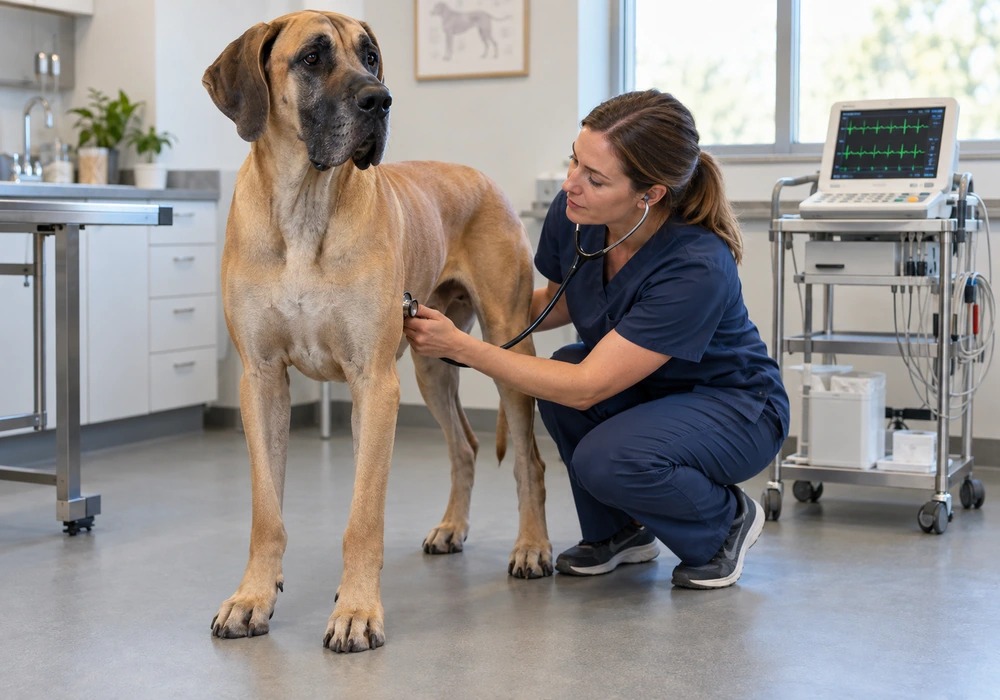
Great Dane Heart Rate: Normal Range and Warning Signs
Great Dane cardiac health Great Dane Heart Rate: Normal Range and Warning Signs Put your fingers on a sleeping Great Dane's pulse and it may feel surprisingly slow. That can

Why Is My Old Dog Suddenly Not Eating
Senior dog appetite guide Why Is My Old Dog Suddenly Not Eating? A skipped meal is not always a crisis. Still, when an older dog suddenly walks away from food,

Why Does My Dog Cough at Night?
Nighttime cough guide Why Does My Dog Cough at Night? A dog may cough at night because the bedroom air is irritating an already sensitive throat. Repeated episodes can also